Categories
Global stocks

Wesco’s Financial Performance Continues to Improve

Business Strategy and Outlook:

In 1994, Westinghouse Electrical sold its electrical distribution business, Westinghouse Electric Supply, or Wesco, to a private equity firm. Wesco went public in 1999. Since its separation from Westinghouse, Wesco has used most of its cumulative free cash flow on acquisitions, which have expanded its scale, diversified revenue, and fuelled a meaningful portion of the company’s growth. Wesco now serves a much broader array of customers across industrial, construction, utility, commercial, institutional, and government markets. Wesco operates in very fragmented markets, but its large scale, global footprint, expansive product portfolio and supplier base, and service offerings differentiate it from smaller local and regional competitors. Service offerings, such as vendor-managed inventory, efficiency assessments, product repairs, and training, generate a meaningful portion of Wesco’s sales and are key components of the firm’s value proposition to customers.

Wesco doubled in size after it completed its acquisition of close peer Anixter in June 2020. We expect the merger to be value-accretive to Wesco’s shareholders. Management is targeting $315 million of cost synergies and $600 million of cross-sales synergies by 2023, which we think is achievable. A combination of factors, including normalizing industrial demand and pricing, the Anixter acquisition, and a continued trend of customers consolidating their spending with larger distributors, will provide ample opportunity for Wesco to gain market share and grow faster than its end markets. Improving gross profit margin performance due to price increases and internal initiatives should also support better profit margins.

Financial Strength:

Wesco’s $4.7 billion acquisition of close peer Anixter International in June 2020 caused the firm’s net debt/EBITDA ratio (excluding synergies) to swell to 5.7. Wesco’s elevated free cash flow generation in 2020 allowed the firm to reduce net debt by $389 million, finishing 2020 with a 5.3 net leverage ratio. At the end of 2021, Wesco had $4.7 billion of debt, but we’re modelling about $4.2 billion of free cash flow over the next five years. As such, management’s goal of reducing its leverage ratio to 2-3.5 by the second half of 2022 is very achievable. Wesco has a proven ability to generate free cash flow throughout the cycle. Indeed, it has generated positive free cash flow (defined as operating cash flow less capital expenditures) every year since its 1999 initial public offering, and its free cash flow generation tends to spike during downturns due to reduced working capital requirements. Given the consistent free cash flow generation, Wesco’s financial health is satisfactory.

Bulls Say’s:

  • Wesco’s transformative acquisition of Anixter should result in stronger growth and profitability, which should help the stock fetch a higher multiple.
  • Wesco’s global footprint and focus on value-added inventory management services help the firm take market share from smaller distributors and support pricing power
  • Despite serving cyclical end markets, Wesco’s business model generates strong free cash flow throughout the cycle. The firm will likely continue to use its cash flow to fund organic growth initiatives, acquisitions, and share repurchases.

Company Profile:

Wesco International is a value-added industrial distributor that has three reportable segments, electrical and electronic solutions, communications and security solutions, and utility and broadband solutions. The company offers more than 1.5 million products to its 125,000 active customers through a distribution network of 800 branches, warehouses, and sales offices, including 42 distribution centers. Wesco generates 75% of its sales in the United States, but it has a global reach, with operations in 50 other countries.

(Source: Morningstar)

General Advice Warning

Any advice/ information provided is general in nature only and does not take into account the personal financial situation, objectives or needs of any particular person.

Categories
Global stocks Shares

Wynn’s Macao Better Than Fears, While Vegas Demand Remains Strong; Shares Undervalued

Business Strategy and Outlook:

Las Vegas demand remains robust, with fourth-quarter sales reaching 134% of 2019 levels, up from 119% last quarter, driven by strong gaming, food and beverage, and room revenue. Wynn plans to sell and leaseback its Boston assets for $1.7 billion, which will be used to pay down debt and invest back into its existing properties and new opportunities, like the property in the United Arab Emirates (scheduled to open in 2026). Wynn will receive management fees for this property and we see this as a good allocation of capital, supporting our Standard capital allocation rating. Macao benefits from a large addressable market (China’s 1.4 billion population), which is captive (only gambling location in China) and underpenetrated (2% of Chinese visited Macao in 2019), with a propensity to gamble (average Macao visitor produced $925 in gaming sales versus $244 in Las Vegas in 2019). Also, supply is limited, with just 41 casinos versus around 1,000 in the United States, supporting operator regulatory advantages, the source of narrow moats in the industry.

Financial Strength:

Wynn’s 2021 sales and EBITDA (pre-corporate expense) of $3.8 billion and $837 million, respectively, surpassed our $3.4 billion and $808 million forecast, driven by better-than-expected Macao sales results. Wynn shares are viewed as undervalued, but prefer shares of narrow-moat Las Vegas Sands, which also trades at a discount to our $53 valuation, while offering stronger assets, along with a stout balance sheet. Macao (76% of 2019 EBITDA) 2021 revenue of $1.5 billion was ahead of our $1.3 billion estimate, while EBITDA of $96 million trailed our $129 forecast. Encouragingly, Wynn saw strong VIP direct play during the recent Chinese New Year, with turnover per day up 175% from 2021 and at 88% of 2019 levels.

Company Profile:

Wynn Resorts operates luxury casinos and resorts. The company was founded in 2002 by Steve Wynn, the former CEO. The company operates four megaresorts: Wynn Macau and Encore in Macao and Wynn Las Vegas and Encore in Las Vegas. Cotai Palace opened in August 2016 in Macao, Encore Boston Harbor in Massachusetts opened June 2019. Additionally, we expect the company to begin construction on a new building next to its existing Macao Palace resort in 2022, which we forecast to open in 2025. The company also operates Wynn Interactive, a digital sports betting and iGaming platform. The company received 76% and 24% of its 2019 prepandemic EBITDA from Macao and Las Vegas, respectively.

(Source: Morningstar)

General Advice Warning

Any advice/ information provided is general in nature only and does not take into account the personal financial situation, objectives or needs of any particular person.

Categories
Global stocks Shares

Revenue of CSL at $6041m up by 4%; however EBIT was 8% weaker

Investment Thesis:

  • Strong FY22 earnings guidance momentum as CSL continues to see strong demand. 
  • Seqirus flu business which recorded its first year of positive earnings (EBIT) in FY18 and continues to perform well.
  • Strong demand for their portfolio of products.
  • High barriers to entry in establishing expertise + global channels + operations/facilities/assets.
  • Strong management team and operational capabilities. 
  • Leveraged to a falling dollar. 

Key Risks:

  • Competitive pressures.
  • Product recall / core Behring business disappoints.
  • Growth disappoints (underperform company guidance).
  • Turnaround in Seqirus flu business stalls or deteriorates.
  • Adverse currency movements (AUD, EUR, USD)

Key highlights:

  • CSL Ltd (CSL) 1H22 results came in ahead of expectations. Net earnings (NPAT) of $1.76bn, down -3%, or -5% on a constant currency (CC) basis.
  • Revenue of $6,041m was up +4%. EBIT of $2,215m, was -8% weaker.
  • Margins of 36.7% was down from 41.1% in the pcp.
  • NPAT of $1.76bn, down -5% (Constant Currency, CC) and likewise, earnings per share $3.77, down -5%, despite revenue up +4% (CC) driven by strong growth CSL’s market leading haemophilia B product IDELVION and specialty products KCENTRA and HAEGARDA.
  • CSL Behring: Total sales of $4,356 was flat, whilst EBIT of $1,331, was -22% weaker
  • Immunoglobulins: sales of $1,977m was down -9% with management pointing to supply tightness temporarily impacting growth. 
  • Albumin: sales of $571m was up +1% due to competitive pressures in the EU as local manufacturers compete for volume and as CSL saw a decline in US as supply constraints stem from plasma collections.
  • Haemophilia: sales of $587m was up +5% with sales in recombinants of $372m, up +12% offset by plasma sales, $215m, down -6%.
  • Specialty: sales of $914m was up +2% despite sales in peri-operative bleeding of $465m, up +8%.
  • Seqirus: revenue of $1,685m was up +17% as seasonal influenza vaccine sales were up +20% and CSL achieved a record volume ~110m doses in the northern hemisphere

Company Description: 

CSL Limited (CSL) develops, manufactures and markets human pharmaceutical and diagnostic products from human plasma. The company’s products include pediatric and adult vaccines, infection, pain medicine, skin disorder remedies, anti-venoms, anticoagulants and immunoglobulins. These products are non-discretionary life-saving products.

(Source: Banyantree)

General Advice Warning

Any advice/ information provided is general in nature only and does not take into account the personal financial situation, objectives or needs of any particular person.

Categories
Dividend Stocks

JB Hi-Fi Ltd interim dividend of 163cps fully franked representing 65% of NPAT and an Off market Buy-Back

Investment Thesis

  • High quality retailer, however trading on a 2-yr PE-multiple of ~15.2x, much of the benefits appear to be factored in (unless we get an upgrade cycle). 
  • Being a low-cost retailer and able to provide low prices to consumers (JB Hi-Fi & The Good Guys) puts the Company in a good position to compete against rivals (e.g., Amazon). 
  • The acquisition of The Good Guys gives JBH exposure to the bulky goods market.
  • Market leading positions in key customer categories means suppliers ensure their products are available through the JBH network.  
  • Clear value proposition and market positioning (recognized as the value brand). 
  • Growing online sales channel. 
  • Solid management team – new CEO Terry Smart was previously the CEO of JBH (and did a great job and is well regarded) hence we are less concerned about the change in senior management. 

Key Risks

  • Increase in competitive pressures (reported entry of Amazon into the Australian market). 
  • Roll-back of Covid-19 induced sales will likely see the stock de-rate. 
  • Increase in cost of doing business. 
  • Lack of new product releases to drive top line growth.
  • Store roll-out strategy stalls or new stores cannibalise existing stores. 
  • Execution risk – integration risk and synergy benefits from The Good Guys acquisition falling short of targets). 

Off – Market Buy Back

  • Total sales were -1.6% to $4.86bn, but up +21.7% over a two-year period. Online sales were up +62.6% to $1.1bn.
  • EBIT was down -9.1% to $420.5m, but up +59.9% over a two-year period.
  • NPAT declined -9.4% to $287.9m but was up +68.8% over a two-year period. This translated to EPS being down -9.4% to 250.6 cps, but likewise, up +68.8% over a two-year period.
  • The Board declared an interim dividend of 163 cps and capital return of up to $250m to shareholders by way of an off-market buy-back. That is, up to $437m to be returned to shareholders through the interim dividend and the off-market buy-back.
  • The last day shares can be acquired on-market to be eligible to participate in the Buy-Back and to qualify for franking credit entitlements in respect of the Buy-Back consideration is 22 February 2022.
  • The Buy-Back is expected to be completed by 20 April 2022.
  • Eligible shareholders will be able to tender their shares at discounts of 8% to 14% to the market price (which will be calculated as the volume weighted average price of its share price over the five trading days up to and including the closing date of 8 April.

Company Profile 

JB Hi-Fi Ltd (JBH) is a home appliances and consumer electronics retailer in Australia and New Zealand. JBH’s products include consumer electronics (TVs, audio, computers), software (CDs, DVDs, Blu-ray discs and games), home appliances (whitegoods, cooking products & small appliances), telecommunications products and services, musical instruments, and digital video content. JBH holds significant market-share in many of its product categories. The Group’s sales are primarily from its branded retail store network (JB Hi-Fi stores and JB Hi-Fi Home stores) and online. JBH also recently acquired The Good Guys (home appliances/consumer electronics), which has a network of 101 stores across Australia.  

(Source: BanyanTree)

General Advice Warning

Any advice/ information provided is general in nature only and does not take into account the personal financial situation, objectives or needs of any particular person.

Categories
Fixed Income Fixed Income

TIAA-CREF Core Plus Bond Fund Premier Class

TIAA-CREF Core Plus Bond has an experienced lead manager and the solid process remains intact, while the expansive supporting cast has only broadened. Veteran manager Joe Higgins, who has led the sibling strategy TIAA-CREF Core Bond TIBDX since 2011, took over this strategy at the end of 2020 when longtime lead manager Bill Martin retired.

Approach

Lead manager Joe Higgins continues the thoughtful relative value approach that has been in place both here and on his other charge, TIAA-CREF Core Bond TIBDX. This strategy earns an Above Average Process Pillar rating. Higgins has the ultimate authority in ensuring what holdings go into the portfolio but draws heavily on the strength and expertise offered by the sector managers, analysts, and macroeconomic strategists in identifying relative value opportunities across the fixed-income universe. The strategy can invest in everything from corporate bonds and mortgages to municipal bonds and emerging-markets debt, with the higher-risk sectors like high-yield bonds, bank loans, and emerging-markets debt ranging between 10% and 30% depending on the team’s outlook and risk appetite.

Portfolio

As of December 2021, the portfolio’s largest exposures were to investment-grade corporate bonds (24.2% of assets), agency mortgage-backed securities (18.6%), and emerging-markets debt (10.2%). The emerging markets exposure rarely if ever broke double-digit threshold, but its allocation has been on the upswing since March 2020 given the portfolio managers’ belief in its ability to outperform over the long term. The emerging markets’ relative lack of direct correlation to domestic corporate moves, as well as premium on offer from new issuance, make them attractive. 

People

Joe Higgins, who replaced longtime lead manager Bill Martin at the end of 2020, is a seasoned and capable manager supported by three experienced comanagers and a robust analyst team. The strategy earns an Above Average People Pillar rating.

Performance

The strategy under Joe Higgins’ tenure has bested almost 70% of distinct peers in the intermediate core-plus bond category, keeping up with the record his predecessor Bill Martin set during his tenure from September 2011 to December 2020. Over that period, the Institutional share class returned 4.5% annualized and outpaced roughly two thirds of peers. While lagging performance punctuated this record at various points, most notably in March 2020, by and large “measured consistency” was the characteristic on display for this strategy’s performance.

(Source: Morningstar)

General Advice Warning

Any advice/ information provided is general in nature only and does not take into account the personal financial situation, objectives or needs of any particular person.

Categories
Funds Funds

Fidelity Sustainable Asia Equity Fund W-Accumulation (UK): Top Picks Among Asian Equity Offerings

Approach

This UK vehicle has formally adopted a sustainability mandate since April 2021. The investment process starts with hard exclusions, which contains firms with material exposure to weapons, tobacco, coal miners, and oil/gas extraction, among others. The exclusion list was further extended in 2021 to include oil/gas/ nuclear power utilities and firms that the team marked to have “deteriorating” ESG momentum within their sustainability rating framework, but it still accounted for less than 5% of the MSCI AC Asia ex Japan Index, and it hasn’t been seen  trigger any material changes to the portfolio over the past year. Dhananjay Phadnis has long favoured quality companies run by strong management teams that can demonstrate cinsistent value creation. It is considered the adoption of a sustainability framework a formalisation of the approach that he has already employed rather than a material change. Phadnis focuses on a firm’s competitive advantages, management quality, potential for improvement on ESG practice, and valuations in stock selection. The end portfolio consists of 50-70 names, which typically are fundamentally sound businesses trading below their intrinsic values and out-of-favour stocks with turnaround catalysts. Sector and country allocations are a residual of stock selection, though weights must stay within 10 percentage points of the index. Phadnis has done an excellent job extracting performance out of the strategy’s risk budget, and his investment savvy brings a further edge to the approach’s execution. Overall, the strategy maintains Process rating of High.

Portfolio

Dhananjay Phadnis increased the portfolio’s exposure to financials to 28.1% as of December 2021 from 19.3% a year ago, which represented a 9.4% overweighting compared with the MSCI AC Asia ex Japan Index. He added to AIA, despite it being a major underperformer in 2021. At Analysts’ January 2022 meeting, Phadnis remained positive on the insurer’s growth outlook, noting that it managed to expand its agent head count and branch out into new provinces in China when other Chinese insurers experienced difficulties in maintaining their agency force in 2021. Conversely, his conviction in Ping An Insurance waned given its slower-than-expected agency reform and its questionable decision of buying a majority stake in bankrupt Founder Group, and he has therefore exited his position. Meanwhile, the December 2021 portfolio continued to have an overweight position in information technology, where its 27.3% stake was above the index’s 25.8%. Phadnis liked SK Hynix, believing that the chipmaker’s acquisition of Intel’s NAND unit will enhance its competitiveness in the global memory market and that it has better corporate governance among Korean companies. Within consumer discretionary (16.1%), Phadnis initiated a stake in Meituan in July 2021 when its valuation became more compelling amid the regulatory crackdown. He believed the food delivery giant’s business model can adapt to new regulatory standards, noting its pricing power and efficient delivery network in the segment.

People

Dhananjay Phadnis brings 20 years of investment experience and has led this strategy’s UK and Luxembourg-domiciled vehicles since November 2013 and March 2015, respectively. He joined Fidelity in 2004 as an analyst and covered a variety of sectors before being promoted to portfolio manager in 2008. He has since posted excellent results across the single-country and regional mandates under his management, though he now focuses on this sustainable Asia equity strategy, which includes the USD 1.2 billion, Luxembourg-domiciled Fidelity Asian Equity fund that Phadnis took over from former manager Suranjan Mukherjee in August 2021. Phadnis had a total AUM of USD 6.1 billion as of December 2021. It is alleged Phadnis is one of the best Asian equity managers, who has consistently showcased astute investment savvy and a great passion for investing. Director of sustainable investing Flora Wang has been the strategy’s assistant portfolio manager since February 2021, when it formally adopted a sustainability mandate. Most of Wang’s contributions currently lie in the ESG integration front, including engaging with companies and identifying materiality issues. She is also gradually developing her fundamental stock-picking skills under Phadnis’ mentorship, and it is monitored how her role evolves. Phadnis is supported by Fidelity’s deep Asia Pacific ex Japan team of 58 analysts who average nine years of experience and six years with Fidelity. The team has showed greater stability since 2020 and has further grown with six additions in 2021 through September. Overall, the strategy continues to merit a People rating of High.

Performance 

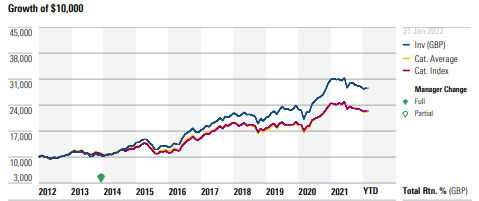
Lead manager Dhananjay Phadnis has delivered excellent results since he took over the UK-domiciled vehicle in November 2013. Through 31 Jan 2022, the W Acc share class returned 12.3% per year (in pound sterling), beating the MSCI AC Asia ex Japan Index’s 8.57% gain, the MSCI Emerging Markets Asia Index’s 8.86% gain, and 96% of its Asia ex Japan equity category peers. Its standard deviation was slightly higher than the indexes but in line with typical peers, resulting in robust risk-adjusted results. Indeed, the share class’ Sharpe ratio of 0.58 during the same period outpaced both indexes and 97% of peers. The outperformance was primarily driven by strong stock selection in China and India, with consumer discretionary, communication services, and financials contributing from a sector perspective. 

Phadnis’ quality bias and prudent risk management helped buoy the strategy’s relative performance in the 2021 down market. Although the W Acc share class lost 3.2% last year, it outperformed the MSCI AC Asia ex Japan Index by 64 basis points and ranked in the 48th percentile among peers. The vehicle primarily benefited from solid stock picks in the communication services and industrials sectors, with Bharti Airtel, NAVER, and Titan Wind Energy being some of the top contributors. The underweightings in Alibaba and Tencent and not owning Pinduoduo also helped, as they plunged on the back of heightened regulatory crackdowns in 2021. Conversely, stock picks in financials and healthcare detracted.

About Fund:

Fidelity International Limited is mainly owned by management and members of the Johnson family, who founded US-based Fidelity Investments. The entities have been separate since 1980, and though there are some similarities, in practice there is only limited alignment between the two. There were a number of personnel changes in 2018-19, including a change in CEO and the CIOs of equities, fixed-income, and multiasset, but the composition of senior management has been relatively stable since. More important, these changes do not seem to have negatively affected day-to-day investment activities, and on the whole, the initiatives undertaken by new management seem sensible.

(Source: Morningstar)

General Advice Warning

Any advice/ information provided is general in nature only and does not take into account the personal financial situation, objectives or needs of any particular person.

Categories
Funds Funds

Vanguard LifeStrategy Conservative Growth Fund Investor Shares: Broadly Diversified, Low-Cost, And Effective

Approach

Vanguard’s efficient, low-cost method provides series’ investors with broad market exposure. The sensible and well-executed approach earns a renewed Above Average Process rating. The equity exposure of the four funds in the lineup (Vanguard LifeStrategy Income VASIX, Vanguard LifeStrategy Conservative Growth VSCGX, Vanguard LifeStrategy Moderate Growth VSMGX, and Vanguard LifeStrategy Growth VASGX) is 20%, 40%, 60%, and 80%, respectively. Vanguard’s strategic asset allocation committee and the investment strategy group provide oversight for the fund series. On an annual basis, the committee reviews the allocations, leveraging research produced by the investment strategy group. The committee takes a cautious tack, which results in a relatively modest approach to implementation changes. Prior to 2011, the series included an allocation to a tactical asset allocation strategy, but that piece was removed, resulting in an exclusively passive underlying fund lineup and strictly strategic procedure. International bond exposure was introduced to the series in 2013, and in 2015 international exposure was increased within both the equity and the fixed-income sleeves: non-U.S. stock exposure increased to 40% from 30% and non-U.S. bond exposure increased to 30% from 20%. The firm’s research suggests that a market-cap weighted approach delivers broad exposure and effectively diversifies the funds but cites investors’ home-country preferences.

Portfolio

As of early 2022, the strategies comprising each portfolio receive compelling ratings. The series’ equity sleeves hold Silver-rated Vanguard Total Stock Market Index VTSMX and Gold-rated Vanguard Total International Stock Index VGTSX. On the fixed-income side, the funds tap Vanguard Total Bond Market II Index VTBIX and Vanguard Total International Bond Index VTIBX, both rated Bronze. The latest addition, Vanguard Total International Bond Index II VTIIX, was launched in February 2021 as a clone of Vanguard Total International Bond Index. The fund is exclusively used in the LifeStrategy and the target retirement series, allowing Vanguard to separate transaction costs generated by the massive target retirement series and LifeStrategy from those generated by other investors. Managers began transitioning the international bond exposure to the clone fund in March 2021 and will continue to do so in a tax-sensitive manner. In the wake of a volatile early 2020, the firm updated the threshold rebalancing policy for multi-asset strategies. Prior to 2021, the rebalancing policy stipulated allocation guardrails of 75 basis points; if exceeded, managers rebalanced the allocations to within 50 basis points of the benchmark. As of Jan. 1, 2021, the new guardrails sat at 200 basis points; if exceeded, managers rebalanced the portfolios to within 100 basis points of the target allocations. This change is reasonable and should reduce the strategy’s rebalancing frequency as intended. 

People

Experienced leadership, a multigroup approach, and robust teams across Vanguard merit a renewed Above Average People rating. The LifeStrategy series is managed by the same teams that oversee the firm’s target retirement funds. Vanguard’s strategic asset allocation committee is responsible for ongoing oversight of multi-asset funds. The committee’s 10 voting members include senior leaders across the firm, such as its global chief economist, who also serves as the committee chair. The strategic asset allocation committee is supported by the firm’s investment strategy group, which is composed of a global network of more than 70 investment professionals. Their research covers an array of topics ranging from investor behavior to portfolio construction. Management of the underlying index funds remains stable and well-resourced. Gerard O’Reilly and Walter Nejman manage the U.S. equity index fund, while Michael Perre and Christine D. Franquin cover the international counterpart. O’Reilly and Perre each have roughly three decades of tenure at Vanguard. Franquin and Nejman have spent 21 and 16 years at Vanguard, respectively. Fixed-income manager Joshua Barrickman joined the firm in 1998 and assumed the role of head of fixed-income indexing in the Americas in 2013. Barrickman manages both the domestic and international bond strategies.

Performance 

Over the trailing 10 years ended January 2022, three of the four funds outperformed their target risk Morningstar Category benchmarks and their allocation fund category peer medians in total annualized returns, respectively. The Moderate Growth fund was the exception: it managed to outpace its Morningstar Moderate Target Risk Index category benchmark but underperformed the typical peer in the competitive allocation — 50% to 70% equity category. On a risk-adjusted basis (as measured by Sharpe ratio) over the same period, all four portfolios outperformed their category benchmarks and their average peer constituent. Notably, the two most conservative funds of the series both landed in the best performing deciles of their respective category peer groups while the most risk-tolerant fund landed in the best performing quintile of the allocation — 70% to 85% equity category group. 

The series’ bond sleeves have a higher duration profile relative to peers, which results in greater sensitivity to changes in interest rates. The recent low-yield environment and threat of rising rates presented a challenge to the profiles here, and for the one-year return ended January 2022, all four portfolios underperformed their respective category peer averages and three of the four underperformed their respective category benchmarks. Only the Growth fund outpaced its Morningstar Moderate Aggressive Target Risk Index category benchmark in that period.

About Fund:

The Vanguard Group earns a High Parent rating for its investor-centric ethos, reliable strategies, and democratization of advice. Vanguard is the asset-management industry’s only client-owned firm, and it shows. Vanguard uses the money that its passive strategies make from securities lending to lower if not eliminate headline expense ratios. Modest fees, capable subadvisors, and performance incentives spur its active business to competitive results. Vanguard also offers advice, human and digital, at an accessible cost. All of this helped its global assets under management grow to USD 7.5 trillion as of March 31, 2021. Yet, Vanguard’s non-U.S. business only accounts for a fraction of its assets. Incumbents within many of these markets have sought to keep this low-cost provider at bay. Vanguard has shifted from leading with exchange-traded funds to using advice for entry, such as its joint venture with China’s Ant Financial to offer a mobile-based retail service, which had more than 1 million Chinese users a year after its April 2020 launch. 

(Source: Morningstar)

General Advice Warning

Any advice/ information provided is general in nature only and does not take into account the personal financial situation, objectives or needs of any particular person.

Categories
Daily Report Financial Markets

Shanghai Market Outlook – 21 February 2022

Categories
Daily Report Financial Markets

Australian Market Outlook – 21 February 2022

Categories
Daily Report Financial Markets

USA Market Outlook – 21 February 2022