Categories
Shares Small Cap

Inghams delivered a strong result in spite of national lockdowns in Australia and NZ

Investment Thesis 

  • The pricing condition is improving.
  • The largest integrated poultry producer in Australia and New Zealand.
  • Additional asset sales are planned.
  • Project Accelerate has proven to be effective in increasing labor productivity and automation, resulting in increased earnings despite lower revenue.
  • Procurement measures are being executed, and the results are meeting expectations.
  • Investing in Australia and New Zealand plants to boost capacity and capabilities across the board.
  • With a healthy balance sheet, capital management measures are high on the agenda.

Key Risks

  • Re-negotiation of important contracts with significant clients on less favourable terms.
  • Increased feed and electricity costs, which could be passed on to customers through market price hikes, lowering competitiveness.
  • Uncertainty arises from the lack of information on the appointment of a new CEO.
  • In QSRs (Quick Service Restaurants) and supermarkets, there is a risk of customer concentration.
  • Exotic disease outbreaks are a risk, limiting ING’s ability to produce poultry goods.
  • From the parent stock provider, there has been a significant decline in volume and quality.
  • Material disruptions in ING’s intricate and interconnected supply chain.

Key FY21 group results 

Despite the impact of Covid-19, ING delivered solid FY21 results that were in line with management’s recent guidance (EBITDA & NPAT) issued on May-21. In comparison to the previous year, group revenue increased by +4.4 percent (with Core Poultry volumes increasing by +4.2 percent, with volume growth in NZ exceedingly strong at +6.3 percent), underlying EBITDA increased by +9.6 percent, and underlying NPAT increased by +57.4 percent. Coverage expansion in wholesale and recovery in the QSR and food service channels drove top-line growth. Total dividends increased +17.9 percent year on year to 16.5cps, representing a payout ratio of 71 percent after earnings growth (in line with policy targets of 60 – 80 percent of underlying NPAT post AASB 16 adjustments). The balance sheet is in excellent shape, with net debt falling by -23.7 percent to $240.2 million in the last year. Group leverage fell from 1.8x to 1.2x, well within management’s 1.0–2.0x target range.

Company Description  

Inghams Group Ltd (ING) is Australia and New Zealand’s largest integrated poultry producer. The Company produces and sells chicken, turkey and stock feed that are used by the poultry, pig, dairy and equine industries. Over one quarantine facility, over ten feed mills, over 74 breeder farms, over 11 hatcheries, over 225 predominantly contracted broiler farms, over seven primary processing plants, over seven further processing plants, over one protein conversion plant, and over nine distribution centres are among the Company’s operations in Australia and New Zealand. Ingham’s and Waitoa are two of the company’s brands.

Source: (BanayanTree)

General Advice Warning

Any advice/ information provided is general in nature only and does not take into account the personal financial situation, objectives or needs of any particular person.


Categories
Technology Stocks

Maintaining BioNTech FVEs after Comirnaty Approval

received full approval from the U.S. Food and Drug Administration on Aug. 23 for individuals age 16 and older. Pfizer and BioNTech fair value estimates are maintained. The mRNA technology that formed the basis of the vaccine provides support to Pfizer’s established wide moat and also contributes to BioNTech’s positive moat trend.

Government contracts for the initial two-dose series and established contracts are more than sufficient to cover any increased demand. The demand for these purchased vaccines could increase with full approval, which could help to end the most recent surge driven by the delta variant. This could encourage some individuals who were uncertain about the long-term safety of the vaccine to get vaccinated. 

In the U.S., roughly 60% of the vaccine-eligible population has been fully vaccinated. President Joe Biden’s target for a return to near normal by July 4 was thwarted by a combination of vaccine hesitancy, waning efficacy of vaccines, and the rise of the more contagious delta variant. Herd immunity could still be achievable, but the delta variant raises the bar; it therefore could depend on new mandates or increased willingness to vaccinate following Pfizer’s Aug. 23 full approval, uptake of third-dose booster shots, and the potential rise of vaccine-resistant variants down the line. 

Company’s Future Outlook

It continues to see sales reaching $35 billion in 2021 and $39 billion in 2022, followed by roughly $2 billion in annual sales beyond 2022 as it is expected post pandemic annual COVID vaccines for only the most vulnerable (infants and seniors). It is expected this approval to give more leverage to public and private organizations wishing to mandate vaccination, including universities and hospitals.

Full approval also makes it easier for doctors to prescribe off-label use of the vaccine, which could provide more flexibility with the timing of booster shots. Most physicians are waiting for a nod from the Centers for Disease Control’s Advisory Committee on Immunization Practices, which could come next week, before recommending booster shots beyond immunocompromised individuals.

Company Profile

BioNTech is a Germany-based biotechnology company that focuses on developing cancer therapeutics, including individualized immunotherapy, as well as vaccines for infectious diseases, including COVID-19. The company’s oncology pipeline contains several classes of drugs, including mRNA-based drugs to encode antigens, neoantigens, cytokines, and antibodies; cell therapies; bispecific antibodies; and small-molecule immunomodulators. BioNTech is partnered with several large pharmaceutical companies, including Roche, Eli Lilly, Pfizer, Sanofi, and Genmab. Comirnaty (COVID-19 vaccine) is its first commercialized product.

(Source: Morningstar)

General Advice Warning

Any advice/ information provided is general in nature only and does not take into account the personal financial situation, objectives or needs of any particular person.

Categories
Dividend Stocks

ASX performed a mixed FY21 as a result of retail trading

Investment Thesis

  • M&A that adds value or product/service innovation
  • Monopoly position in a number of segments, with an EBIT margin of 70% and ROTE of 30%.
  • A quality management team has been established to assist any new CEO. The team has a detailed awareness of future operational and IT requirements, as well as strong ties to legislators and regulators.
  • With net cash and an AA credit rating, the balance sheet is strong.
  • The ASX stands to profit from rising superannuation and population trends.
  • The ASX could profit from global connectivity’s fundamental expansion.

Key Risks

  • Capex execution runs the risk of falling short of expectations in terms of ROIC.
  • Volume growth is expected to be slow, while profitability are expected to be flat.
  • Competitors’ or a new start-technological up’s and product innovation could jeopardise ASX’s market hegemony.
  • Regulation poses a threat.

FY21 results summary

Operating revenue increased +1.4 percent year on year to $951.5 million, driven by strong growth in Listings& Issuer Services (supported by new listings and increased issuer activity), Equity Post-Trade Services (reflecting higher settlement activity), and Trading Services (underpinned by increased demand for information services), partially offset by declines in Derivatives and OTC Markets as current policy settings reverted. Total expenses increased by +8.4 percent years on year to $310.3 million, in line with management’s guidance of +8-9 percent growth, due to additional costs to support licence to operate and growth initiatives, as well as variable costs associated with issuer activity. EBIT fell -1.7 percent years on year, with margin falling -210 basis points to 67.4 percent. Statutory profit was -3.6 percent lower than pcp. Net interest income fell 44.3 percent year on year to $46.7 million as a result of the RBA’s current policy settings, which resulted in lower interest earnings on ASX’s own capital and a lower investment spread on ASX collateral. Capital expenditure (capex) was $109.8 million, up 36.5 percent year on year, reflecting the expanded CHESS replacement project and ASX’s ongoing commitment to strengthen foundations for a future exchange.

Company Description  

ASX Ltd (ASX) operates Australia’s main stock exchange and equity derivatives market. ASX has four core segments:  (1) Listings and Issuer Services (covers capital raisings, investment products, and a range of services ASX provide to listed companies); (2) Derivatives and OTC Markets (covers OTC Clearing, equity options and Austraclear including the ASX collateral management service); (3) Trading Services (encompasses cash equities trading, information services and technical services); and (4) Equity Post-Trade Services (encompasses the clearing and settlement of the entire Australian cash market).

General Advice Warning

Any advice/ information provided is general in nature only and does not take into account the personal financial situation, objectives or needs of any particular person.

Categories
Global stocks Shares

Analysts estimate increase in Stifel Fair Value

Additionally, an initial need for capital in the recession and then low interest rates and a strong stock market led to high capital-raising activity.

Stifel Financial has a long history of being an active acquirer. With several hundred million dollars of arguably excess capital, the company could make some decent-size acquisitions. The company may see some growth from a renewed commitment to its independent advisor business.

Stifel has been deepening its expertise in certain niche areas lately through acquisitions. The KBW merger improved the company’s presence in financial industry investment banking, and Stifel has made a series of public finance firm acquisitions over the past several years. In wealth management, adding Barclays’ advisors can help the firm move more upmarket. The investment banking and wealth management landscape is undergoing a decent amount of change from regulations, such as those related to capital requirements and fiduciary standards.

Financial Strength:

Stifel’s financial health is fairly good. At the end of 2020, the company had approximately $1.1 billion of corporate debt and over $2 billion of cash on its balance sheet. Its next large debt maturity is $500 million in 2024.The Company’s total leverage is less than 8, which is fair considering the mix of its investment banking and traditional banking operations. At the end of 2020, Stifel was at its disclosed target of 11.9% Tier 1 leverage ratio. Given that its Tier 1 leverage ratio is above management’s previously stated target of 10%, the company would resume more material share repurchases or pursue acquisitions. 

Bulls Say:

Stifel’s string of acquisitions has increased operational scale and expertise. Stifel is an experienced acquirer and integrator. A recession could provide ample acquisition opportunities. Net interest income growth over the previous several years at the company’s bank materially expanded wealth management operating margins, and the increased size of the bank and wealth management business provides diversification with its institutional securities business.

Company Profile:

Stifel Financial is a middle-market-focused investment bank that produces more than 90% of its revenue in the United States. Approximately 60% of the company’s net revenue is derived from its global wealth management division, which supports over 2,000 financial advisors, with the remainder coming from its institutional securities business. Stifel has a history of being an active acquirer of other financial service firms.

(Source: Morningstar)

General Advice Warning

Any advice/ information provided is general in nature only and does not take into account the personal financial situation, objectives or needs of any particular person.

Categories
Global stocks

G8 Education Fair Value Cut to AUD 2.00 but Remains Materially Undervalued

Although the result contained several positive aspects, we now expect some of G8’s recent expenses growth to be permanent. This expectation results in a reduction in our long-term profit margin expectations, with our long-term underlying NPAT margin forecast falling to 12% from 14%.

The market reacted negatively to G8’s result, with the share price falling 6% on the day. G8 usually generates most of its revenue in the second half of the year which typically boosts profit margins. However, the company has been unable to increase prices as usual in the middle of this year, due to the pandemic, which will impact margins in the second half. G8’s prices have been unable to keep pace with wages growth over the past couple of years, partly due to lower immigration due to the pandemic. Although management have created strategies to address the scarcity of labour and labour productivity, these solutions have costs too. G8’s earnings are particularly sensitive to wage inflation because wages typically equate to around 60% of revenue and because G8’s margins are relatively small.

G8’s management said that attracting and retaining talent is the greatest challenge facing the sector. In July 2021, G8’s occupancy rate had recovered to just 1 percentage point below levels achieved in July 2019, before the pandemic. However, the coronavirus outbreak and related lockdowns have caused this gap to widen to 2.6 percentage points in August 2021, relative to August 2019. We expect the second half of 2020 will be tough for G8, with lockdowns likely to continue for most of the half. However, we also expect Australian vaccination rates to enter 2022 with 70% to 80% of the population likely vaccinated, paving the way for a permanent reopening of the country.

Although the latest childcare sector support measures are a positive for childcare centre operators, they only add to the complexity of forecasting G8’s near-term earnings. Aside from the complexity caused by the pandemic’s impact on occupancy rates and subsidies, G8’s earnings are also distorted by recent reshuffling of its childcare centre portfolio, re -categorisation of expenses, the ramp-up of new centres, and change to the definitions of key performance indicators, such as occupancy. This complexity may mean the market will remain wary of G8 shares until the expected recovery is evidenced in reported results, likely in late 2022.

Despite our lower fair value, at the current market price of AUD 0.99 per share, we continue to believe G8 is materially undervalued. Although the childcare industry faces turmoil in the near term and wage inflation pressures in the longer term, we still expect G8’s occupancy rates to recover in 2022 as the pandemic subsides. Importantly, G8’s decision to raise equity capital in 2020, and repay all its net debt, means the company is well placed to weather the latest lockdowns and will likely reinstate dividends in 2022. The reinstatement of G8’s dividends will be an important step for Australian tax residents, because they will likely be fully franked. Franked dividends are effectively a return of corporate tax to shareholders and the reinstatement of franked dividends, which we expect in early 2021, may be a catalyst for a rerating of the stock.

Company Profile

G8 Education operates a portfolio of around 480 childcare centres in Australia, implying a market share of around 8%. The company is highly dependent on government subsidies, which comprise around 60% of childcare fees, but we expect subsidies to continue growing with childcare demand. G8 does not own the buildings from which its childcare centres operate, and labour costs comprise around 60% of expenses, with rental costs comprising around 15%.

(Source: Morningstar)

General Advice Warning

Any advice/ information provided is general in nature only and does not take into account the personal financial situation, objectives or needs of any particular person.

Categories
Global stocks Shares

Positive effect on Amcor stock as the company’s net income and free cash flow increase

  • Flattering exposure to the growth of both emerging and developed markets.
  • A well-defined strategy for increasing shareholder value.
  • Acquisitions that are bolt-ons provide an opportunity to supplement organic growth.
  • A strong balance sheet.
  • Leveraged against a falling AUD/USD
  • Advantages from the recently finished Bemis acquisition will begin to flow.
  • Capital management initiatives include a $500 million share buyback currently underway.

Key Risks

The following are the key challenges to the investment thesis:

  • Management fails to realise the proposed synergies in the Bemis transaction.
  • Increasing competition causing margin erosion and potential balance-sheet stress (e.g. reduced earnings leading to potential debt covenant breaches).
  • Cost constraints on inputs that the company is unable to pass on to customers (even though the Company does pass through input costs).
  • Global economic growth has slowed.
  • Value-destroying acquisition.
  • The risk of emerging markets.
  • Unfavorable movements in the AUD/USD.

Highlights of key FY21 results

  • EBIT increased by 8% to $1,621 million, with margins enhancing by +60 basis points to 12.6 percent. 
  • GAAP net income of $939 million, a +53 percent increase, translates to GAAP EPS of 60.2 cents, a +58 percent increase (or adjusted EPS of 74.4 cents, a +16 percent increase on a CC basis, above guidance range).
  • Adjusted FCF of $1.1bn, flat -9.9 percent over pcp (albeit at the upper end of guidance range), effected by rising capex on organic growth projects, lower working capital benefit, and adverse tax payment timing compared to pcp.
  • Return on average funds employed of 15.4 percent, an increase of +140 basis points over the pcp. 
  • The Board declared a final dividend of 11.75 cents per share, bringing the full-year dividend to 47 cents per share, and repurchased $350 million (2% ) of outstanding shares.

Company Description 

Amcor Limited (AMC) is an international integrated packaging company offering packing and related services. Amcor primarily produces a wide range of packaging products which include corrugated boxes, cartons, aluminum and steel cans, flexible plastic packaging, PET plastic bottles and jars, and multi-wall sacks. The company has operations in Australasia, North America, Latin America, Europe and Asia.

General Advice Warning

Any advice/ information provided is general in nature only and does not take into account the personal financial situation, objectives or needs of any particular person.

Categories
Dividend Stocks

P&G Cleans Up in Fiscal 2021, but Inflationary and Competive Headwinds Could Stall Its Trajectory


 However, this performance is not solely a by-product of the pandemic, which has seen consumers place an outsize emphasis on cleaning and disinfecting. Rather, we attribute these marks to the strategic course P&G embarked on more than seven years ago (rightsizing its category and geographic reach by shedding more than 100 brands to ensure resources were being effectively allocated to the highest-return opportunities, while maintaining a stringent focus on costs). As a part of this playbook, P&G also adopted a more holistic approach to brand investing across its business .

But even as its top line appears healthy, P&G is facing unrelenting commodity cost inflation that management has qualitatively pegged as some of the most significant in some time. However, we think the degree of inflation combined with P&G’s innovation mandate (rooted in consumer-valued new fare) should make such increases more palatable. Further,  P&G is now involved in leaning into brand spending to illustrate the value its products offer consumers as opposed to turning off the spigot to preserve profits in this uncertain climate. This aligns with our forecast for P&G to direct around 3% and 10%-11% of sales long term to research and development and marketing, respectively, relative to the 2.7% and 10.5% expended on average the past five years.

Financial Strength

P&G maintains solid financial health. The firm continues to throw off a significant amount of cash, with free cash flow amounting to around $15 billion in fiscal 2021 .We expect P&G will remain committed to returning excess cash to shareholders and will increase its dividend, to an average payout ratio north of 60%. For the year 2020 the firms revenue stood at 70.950 USD million while its EBIT was 16,143 USD million. On the other hand the firms EV/EBIDTA was 18.2 while its P/E ratio was 23.4 for the year 2020.

 We believe P&G is also open to bolting on select brands and businesses to its mix over time. The firms acquired Germany-based narrow-moat Merck’s consumer healthcare brands for $4 billion in April 2018. In our view, this deal stood to replace the scale and technological know-how lost following the dissolution of its joint venture partnership with no-moat Teva at the end of fiscal 2018. As such, we don’t think it signals a reversal in the firm’s strategy to operate with a leaner brand mix. Rather, at just 1%-2% of sales, we believe this addition aligned with management’s rhetoric that it intends to selectively bolster its reach in attractive categories (consumer health growing midsingle digits) and geographies. Beyond this deal, P&G has failed to assert itself as a consolidator in the global household and personal-care arena.

Bulls Say

  • To the extent that retailers and consumers continue to find favour with leading branded operators, P&G’s sales trajectory may outpace our expectations.
  • Additional opportunities to narrow its product mix could enable P&G to more effectively direct its brand spending to the highest-return areas.
  • As P&G reaches the end of its second $10 billion cost reduction effort, further savings (probably related to reducing overhead and bolstering the yield on its manufacturing footprint and marketing investments) could manifest if efficiency is as engrained in its culture as management suggests.

Company Profile

Since its founding in 1837, Procter & Gamble has become one of the world’s largest consumer product manufacturers, generating more than $75 billion in annual sales. It operates with a line up of leading brands, including 21 that generate more than $1 billion each in annual global sales, such as Tide laundry detergent, Charmin toilet paper, Pantene shampoo, and Pampers diapers. P&G sold its last remaining food brand, Pringles, to Kellogg in calendar 2012. Sales outside its home turf represent around 55% of the firm’s consolidated total, with around one third coming from emerging markets.

(Source: Morningstar)

General Advice Warning

Any advice/ information provided is general in nature only and does not take into account the personal financial situation, objectives or needs of any particular person.

Categories
Global stocks Shares

Cleanaway’s Asset Acquisition of Suez in F.Y.22

 It is clear about Cleanaway’s growth into materials recovery which features more favorable economics than waste collection. Under its “Footprint 2025” capital allocation strategy, the group will continue to focus investment in materials recovery and waste-to-energy, or WTE. 

Since fiscal 2016, Cleanaway has invested in excess of AUD 100 million in Greenfield materials recovery, waste treatment, and WTE projects. The recent purchase of the materials recovery assets of SKM Recycling represents a further step toward Cleanaway’s goal of moving further into the industry’s midstream.

Further diversifying Cleanaway away from waste collection is the acquisition of Toxfree in late fiscal 2018, skewing Cleanaway’s earnings stream away from collections, the most competitive segment of the waste management value chain.

Financial Strength

Cleanaway has made further progress on its proposed AUD 501 million acquisition of key Australian post-collection assets from Suez, securing new debt facilities which will allow the deal to be fully debt funded. Therefore, balance sheet flexibility post deal completion exists should further acquisition opportunities arise. Cleanaway’s liquidity position is more than ample to secure the business’ operations without external financing through the medium-term. With minimal debt maturities over the fiscal 2021-24 period, Cleanaway’s sources of cash—those being cash at bank, undrawn debt and operating cash flow–are more than sufficient to fund Cleanaway’s ongoing operations. Cleanaway’s earnings exhibit little volatility through the economic cycle. As a result, its conservatively positioned balance sheet provides ample flexibility for further capital allocation to materials recovery and waste disposal assets —whether bolt-on or Greenfield–under Cleanaway’s Footprint 2025 strategy. 

Bull Says

  • Cleanaway is benefiting from industry consolidation.
  • Municipal waste contracts provide relatively stable cash flows through the economic cycle.
  • Capital allocation improved markedly under outgoing CEO Vik Bansal’s guidance.

Company Profile

Cleanaway Waste Management (ASX: CWY) is Australia’s largest waste management business with a national footprint spanning collection, midstream waste processing, treatment and valorization, and downstream waste disposal. Cleanaway is active in municipal and commercial and industrial, or C&I, waste stream segments and in nonhazardous and hazardous liquid waste and medical waste streams following the acquisition of Toxfree in fiscal 2018. While Cleanaway is allocating greater capital to midstream waste processing and treatment, earnings remain skewed toward waste collection. Cleanaway is particularly strong in C&I and municipal waste collection with strong market share in all large Australian metro waste collection markets.

 (Source: Morningstar)

General Advice Warning

Any advice/ information provided is general in nature only and does not take into account the personal financial situation, objectives or needs of any particular person.

Categories
Funds Funds

A prudent and strong investment strategy that produced absolute returns

Philosophy of the Fund

The Fund’s investment philosophy is based on identifying long-term fundamental value picks that are both listed and unlisted. RARE believes that significant opportunities emerge during economic cycles as markets misprice infrastructure assets in the short term. In the RARE Emerging Markets Strategy, an accumulation index comprised of the FTSE EM Gov Bond Index USD plus 5.0 percent per year is used as a benchmark.

Investment Procedure

The investment team conducts fundamental analysis and valuation in order to identify ‘pure infrastructure’ assets with monopolistic characteristics, long contractual duration, and relatively stable cash flows. In particular, the investments must meet three key requirements:

  • The asset must be a hard-physical asset; 
  • The asset must provide a valuable service to society; and 
  • The asset should have strong foundations in place to ensure equity holders are adequately rewarded.

With these characteristics in mind, RARE uses the ‘RARE EM 150’ as the proprietary investment universe for their Emerging Market Strategy. Included in this list are companies in the MSCI Emerging Markets or Frontier Emerging Markets Index, as well as companies that are listed in other markets but produce a majority of their operating earnings from activities related to emerging markets. Of the 150 securities, 40% of these companies are considered Core and consistently covered, while the remaining 60% are watch listed and updated at least once a year. On a quarterly basis, the composition of the ‘RARE EM 150’ is reviewed by the Investment Leadership Team.

Sector exposure limits are also placed, with a clear preference towards regulated utilities and transport. The Fund notes this is due to their relatively stable performance, and typically lower risk nature in comparison to user-pay assets.

Source: RARE Infrastructure

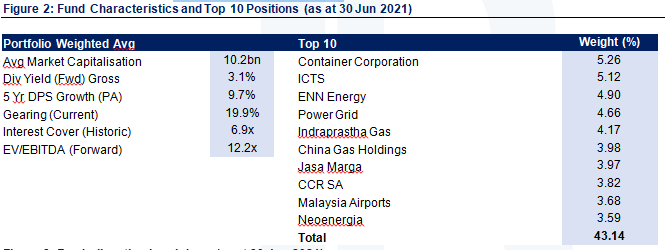
Fund Positioning 

General Advice Warning

Any advice/ information provided is general in nature only and does not take into account the personal financial situation, objectives or needs of any particular person.
Categories
Technology Stocks

Tenet Continues to be More Efficient and Profitable

the wake of an acquisition strategy that left it with operating inefficiencies and a debt-heavy balance sheet. Led by initiatives endorsed by its largest shareholder, Glenview Capital Management (15% stake as of March), Tenet has replaced top leadership, refreshed the board, improved governance practices, pruned its portfolio of assets, and undergone a restructuring effort. 

Operationally, Tenet has focused on flattening layers of management, improving operating efficiencies both inside and outside its healthcare facilities, and increasing focus on service quality. All these factors appear to be positively influencing returns on invested capital at Tenet, which began exceeding its weighted average cost of capital in 2017 by our calculations for the first time since the Vanguard Group acquisition in 2013.

Despite all of these positives, the company still operates with substantial debt on its balance sheet and is currently rated in the broad single B category by the major credit rating agencies on an unsecured basis. 

Financial Strength

It is expected Tenet to at least meet its net leverage goal of 5.0 times by the end of 2021, which would be a positive development in the odyssey that has been Tenet’s credit story since the Vanguard acquisition in 2013. At the end of June, the firm held $2.2 billion in cash, which included aid from the government and new borrowings. While Tenet will need to pay back Medicare advances and payroll tax deferrals, it looks to be in good shape to do so, even after paying $1.1 billion for the recent acquisition of the SCD ambulatory surgery center assets in late 2020. Tenet recently agreed to sell five Miami-area hospitals for $1.1 billion. The company also aims to spin off its revenue cycle management business, Conifer, in the near future, which could be a source of funds to meet its debt obligations as well.

Bull Says

  • With a new management team in place since late 2017, Tenet has become a more efficient and more profitable organization, suggesting that the team is making progress operationally.
  • As the top provider of ambulatory care services in the U.S., Tenet should be able to continue benefiting from the ongoing shift of procedures to outpatient facilities from acute-care hospitals, which could boost growth and margins.
  • Tenet continues to focus on improving its balance sheet and could meet its deleveraging goal on a sustainable basis in 2021.

Company Profile

Tenet Healthcare Corporation (NYSE: THC) is a Dallas-based healthcare provider organization operating a collection of hospitals (65 at the end of 2020) and over 550 outpatient facilities, including ambulatory surgery centers, urgent care centers, freestanding imaging centers, freestanding emergency rooms/micro-hospitals, and physician practices across the United States. Tenet enjoys the number-one ambulatory surgical center position nationwide, as well.

 (Source: Morningstar)

General Advice Warning

Any advice/ information provided is general in nature only and does not take into account the personal financial situation, objectives or needs of any particular person.