Categories
Funds Funds

Bennelong ex-20 Australian Equities Fund: Has a track record of adding value by outperforming the market over the long-term

Fund Objective

The Fund’s objective is to grow the value of your investment over the long term via a combination of capital growth and income, by investing in a diversified portfolio of primarily Australian shares, providing a total return that exceeds the S&P/ASX 300 Accumulation Index by 4% per annum after fees (measured on a rolling three-year basis). 

Fund Strategy

The portfolio comprises securities purchased primarily from, but not limited to, the S&P/ASX 300 Index (but excluding those securities in the S&P/ASX 20 Index). The Fund may invest in securities expected to be listed on the ASX except those expected to be included in the S&P/ASX 20 Index upon listing. The Fund may also invest in securities listed, or expected to be listed, on other exchanges where such securities relate to ASX-listed securities. Derivative instruments may be used to replicate underlying positions on a temporary basis and hedge market and company-specific risks. The Fund cannot purchase securities that are in the S&P/ASX 20 Index. However, when a security that is held within the Fund moves into the S&P/ASX 20 Index, that security may continue to be held for so long as deemed appropriate. The investment team will use its discretion in selling down that security, having regard to the best interests of unitholders. In this way, the Fund may hold securities in the S&P/ASX 20 Index from time to time.

Portfolio Performance

Investment Team:

The BAEP investment team consists of eight investment professionals:

  1. Mark East: Chief Investment Officer and Portfolio Manager 
  2. Keith Hwang: Director, Quantitative Research 
  3. Neale Goldstone-Morris: Senior Investment Analyst, Strategy 
  4. Kieran Sisson: Senior Investment Analyst 
  5. Doug Macphillamy: Senior Investment Analyst 
  6. Brad Clibborn: Senior Investment Analyst 
  7. Jack Briggs: Senior Investment Analyst 
  8. Todd Briggs: Investment Analyst 

In the last two years, there has been one hire Doug Macphillamy: Senior Investment Analyst and one departure Julian Beaumont.

BAEP operates under a flat organisational structure with all team members contributing to the investment decision making process. This model has been deliberately adopted to ensure a collaborative effort and avoid a hierarchical structure. Collectively, the investment team has experience in portfolio management; fundamental, macroeconomic, strategy & quantitative research and analysis, and in trading & execution. There is a series of constant checks, balances and back-ups in the business and investment process which support its structure. Mark East (CIO) has the final say on portfolio construction and ultimately accountability/responsibility. The portfolio manager is supported by the extensive resourcing within the broader BAEP investment team. Keith Hwang has primary responsibility for trading and execution, with Kieran Sisson acting as back-up.

About Fund:

Bennelong ex-20 Australian Equities Fund’s objective is to outperform the S&P/ASX 300 Accumulation Index excluding the portion of return attributed to the S&P/ASX 20 Leaders Index, by 4% per annum after fees on a rolling 3-year basis. The Fund invests primarily in Australian shares with high quality business models, strong growth, and underestimated earnings momentum and prospects.

(Source: Banyantree, investmentcentre)

DISCLAIMER for General Advice: (This document is for general advice only).

This document is provided by Laverne Securities Pty Ltd T/as Laverne Investing. Laverne Securities Pty Ltd, CAR 001269781 of Laverne Capital Pty Ltd AFSL No. 482937.

The material in this document may contain general advice or recommendations which, while believed to be accurate at the time of publication, are not appropriate for all persons or accounts. This document does not purport to contain all the information that a prospective investor may require.  The material contained in this document does not take into consideration an investor’s objectives, financial situation or needs. Before acting on the advice, investors should consider the appropriateness of the advice, having regard to the investor’s objectives, financial situation, and needs. The material contained in this document is for sales purposes. The material contained in this document is for information purposes only and is not an offer, solicitation or recommendation with respect to the subscription for, purchase or sale of securities or financial products and neither or anything in it shall form the basis of any contract or commitment. This document should not be regarded by recipients as a substitute for the exercise of their own judgment and recipients should seek independent advice.

The material in this document has been obtained from sources believed to be true but neither Laverne and Banyan Tree nor its associates make any recommendation or warranty concerning the accuracy or reliability or completeness of the information or the performance of the companies referred to in this document. Past performance is not indicative of future performance. Any opinions and or recommendations expressed in this material are subject to change without notice and, Laverne and Banyan Tree are not under any obligation to update or keep current the information contained herein. References made to third parties are based on information believed to be reliable but are not guaranteed as being accurate.

Laverne and Banyan Tree and its respective officers may have an interest in the securities or derivatives of any entities referred to in this material. Laverne and Banyan Tree do and seek to do business with companies that are the subject of its research reports. The analyst(s) hereby certify that all the views expressed in this report accurately reflect their personal views about the subject investment theme and/or company securities.

Although every attempt has been made to verify the accuracy of the information contained in the document, liability for any errors or omissions (except any statutory liability which cannot be excluded) is specifically excluded by Laverne and Banyan Tree, its associates, officers, directors, employees, and agents.  Except for any liability which cannot be excluded, Laverne and Banyan Tree, its directors, employees and agents accept no liability or responsibility for any loss or damage of any kind, direct or indirect, arising out of the use of all or any part of this material.  Recipients of this document agree in advance that Laverne and Banyan Tree are not liable to recipients in any matters whatsoever otherwise; recipients should disregard, destroy or delete this document. All information is correct at the time of publication. Laverne and Banyan Tree do not guarantee reliability and accuracy of the material contained in this document and are not liable for any unintentional errors in the document.

The securities of any company(ies) mentioned in this document may not be eligible for sale in all jurisdictions or to all categories of investors. This document is provided to the recipient only and is not to be distributed to third parties without the prior consent of Laverne and Banyan Tree.

Categories
Funds Funds

Magellan Global Fund Open Class: Investment process focuses on high quality, liquid companies

Investment Objective

The investment objectives of the Fund are to achieve attractive risk-adjusted returns over the medium to long-term, while reducing the risk of permanent capital loss.  

Investment Process

The investment objective of the strategy is two-fold: 

  1. Achieve attractive risk adjusted returns over the medium to long-term (translates to 9% p.a. net of fees long-term target)
  2. Minimise the risk of permanent capital loss (downside protection)

The Magellan Global Fund aims to invest in ‘outstanding companies’ at attractive prices, while also managing investment risk through a comprehensive understanding of the macroeconomic and broader environment. ‘Outstanding’ in this context refers to companies that are able to “sustainably exploit competitive advantages in order to continually earn returns on capital that are materially in excess of their cost of capital.” As such, the Fund is not deterred by companies that may be perceived as trading expensively (e.g. at high multiples), so long as their underlying businesses are outstanding, and share prices are assessed to be trading at a discount to intrinsic value.

The investment team assesses each stock via five quality criteria (economic moat, re-investment potential, business risks, agency risks, and ESG factors).  This analysis reduces the universe to around 300 stocks which then undergo detailed bottom-up analysis.  The team discusses the results to determine stocks that will be recommended to the investment committee. Investments will need to have a margin of safety (discount to intrinsic value) to enter the portfolio.

The stringent quality criteria result in a concentration in global franchises, information technology, global infrastructure and niche financial services companies. Analysts build discounted cash flow models to determine the intrinsic value of each company. A “conviction scoring matrix” is also used to ensure that each company is consistently evaluated both relative to peers and on a standalone basis.

Portfolio

Investment Team 

In February 2022, CIO and Lead Portfolio Manager Hamish Douglass took, effective immediately, a medical leave of absence for personal reasons and mental health issues. It is important to note, the Company does expect Mr Douglass to return in due course when he is healthy to return. 

In June 2022, the Manager announced that Mr. Douglass will cease to be a permanent member of Magellan’s staff on 15 June 2022 and will commence the consultancy role on 1 October 2022. Mr. Douglass will be available to the investment team, as required by them, to share his insights including his views on macroeconomic and geo-political matters.

In the interim, Chris Mackay (Magellan’s co-founder) will step in and oversee the portfolio management of Magellan’s global equity retail funds and global equity institutional mandates. Chris is a highly experienced Portfolio Manager with a solid track record in global equities. Further, Nikki Thomas has re-joined Magellan as a Co-portfolio manager of Magellan’s global equity strategies. Nikki was due to commence in March however due to this announcement, she agreed to start 7th February. Nikki is a highly regarded Portfolio Manager with over 20 years of experience in the management of global equity portfolios. Nikki was instrumental in the development of the Magellan investment team’s processes in 2006, and she has a deep knowledge of Magellan’s investment universe. Her experience and relationships with investment advisers and consultants will add further depth to the investment team. Chris Mackay will be working with Deputy CIO Dom Giuliano, Nikki Thomas, Arvid Streimann and Chris Wheldon in respect of the co-management of the global equity and high conviction retail funds and institutional mandates.

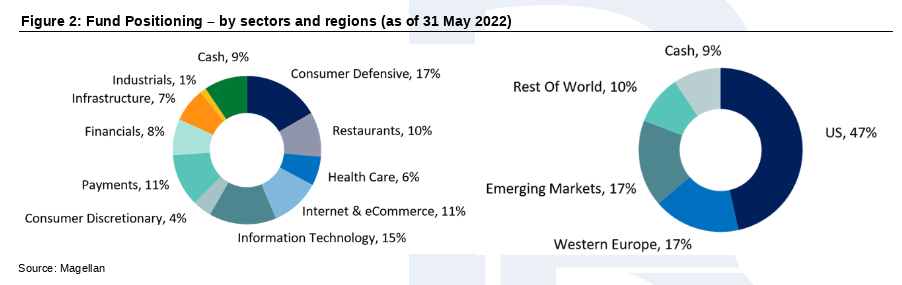
Fund Performance and Positioning 

About Fund:

The Magellan Global Fund (Unhedged) is a concentrated, currency unhedged, benchmark unaware international equities strategy that typically contains 20-40 stocks. The objectives are capital preservation and reduction of downside volatility risk, while having a minimum return objective of 9% p.a. (net of fees).

(Source: Banyantree)

DISCLAIMER for General Advice: (This document is for general advice only).

This document is provided by Laverne Securities Pty Ltd T/as Laverne Investing. Laverne Securities Pty Ltd, CAR 001269781 of Laverne Capital Pty Ltd AFSL No. 482937.

The material in this document may contain general advice or recommendations which, while believed to be accurate at the time of publication, are not appropriate for all persons or accounts. This document does not purport to contain all the information that a prospective investor may require.  The material contained in this document does not take into consideration an investor’s objectives, financial situation or needs. Before acting on the advice, investors should consider the appropriateness of the advice, having regard to the investor’s objectives, financial situation, and needs. The material contained in this document is for sales purposes. The material contained in this document is for information purposes only and is not an offer, solicitation or recommendation with respect to the subscription for, purchase or sale of securities or financial products and neither or anything in it shall form the basis of any contract or commitment. This document should not be regarded by recipients as a substitute for the exercise of their own judgment and recipients should seek independent advice.

The material in this document has been obtained from sources believed to be true but neither Laverne and Banyan Tree nor its associates make any recommendation or warranty concerning the accuracy or reliability or completeness of the information or the performance of the companies referred to in this document. Past performance is not indicative of future performance. Any opinions and or recommendations expressed in this material are subject to change without notice and, Laverne and Banyan Tree are not under any obligation to update or keep current the information contained herein. References made to third parties are based on information believed to be reliable but are not guaranteed as being accurate.

Laverne and Banyan Tree and its respective officers may have an interest in the securities or derivatives of any entities referred to in this material. Laverne and Banyan Tree do and seek to do business with companies that are the subject of its research reports. The analyst(s) hereby certify that all the views expressed in this report accurately reflect their personal views about the subject investment theme and/or company securities.

Although every attempt has been made to verify the accuracy of the information contained in the document, liability for any errors or omissions (except any statutory liability which cannot be excluded) is specifically excluded by Laverne and Banyan Tree, its associates, officers, directors, employees, and agents.  Except for any liability which cannot be excluded, Laverne and Banyan Tree, its directors, employees and agents accept no liability or responsibility for any loss or damage of any kind, direct or indirect, arising out of the use of all or any part of this material.  Recipients of this document agree in advance that Laverne and Banyan Tree are not liable to recipients in any matters whatsoever otherwise; recipients should disregard, destroy or delete this document. All information is correct at the time of publication. Laverne and Banyan Tree do not guarantee reliability and accuracy of the material contained in this document and are not liable for any unintentional errors in the document.

The securities of any company(ies) mentioned in this document may not be eligible for sale in all jurisdictions or to all categories of investors. This document is provided to the recipient only and is not to be distributed to third parties without the prior consent of Laverne and Banyan Tree.

Categories
Funds Funds

Vanguard Australian Shares Index Fund; Offers potential Long Term Capital Growth along with Dividend income and Franking Credits

Investment Objective

Vanguard Australian Shares Index Fund seeks to track the return of the S&P/ASX 300 Index before taking into account fees, expenses and tax.

Investment Strategy and Investment Return Objective

The Fund seeks to track the return of the S&P/ASX 300 Index before taking into account fees, expenses, and tax. The S&P/ASX 300 Index includes the large cap, mid cap and small cap components of the S&P/ASX index family. The Fund will hold all of the securities in the index most of the time, allowing for individual security weightings to vary marginally from the index from time to time. The Fund may invest in securities that have been removed from or are expected to be included in the index. The Fund may engage in securities lending. Securities lending is a common practice where holders of securities make short term loans of shares in return for a fee, to incrementally increase returns to investors.

Performance Return

About Fund:

Vanguard Investments Australia Ltd (“Vanguard”) is a wholly owned subsidiary of The Vanguard Group, Inc. The Vanguard Group, Inc. is one of the world’s largest global investment management companies, with more than AUD $8.6 trillion in assets under management as of 31 March 2020. In Australia, Vanguard has been serving financial advisers, retail clients and institutional investors for more than 20 years. Vanguard is the responsible entity of the Fund. As responsible entity, Vanguard is solely responsible for the management and administration of the Fund. Vanguard is also the investment manager for the Fund and has appointed other entities within the Vanguard group of companies to provide investment management related services to the Fund. Investors will be notified of any future change in the investment manager of the Fund and this PDS will be updated accordingly. 

(Source: https://www.vanguard.com.au/)

DISCLAIMER for General Advice: (This document is for general advice only).

This document is provided by Laverne Securities Pty Ltd T/as Laverne Investing. Laverne Securities Pty Ltd, CAR 001269781 of Laverne Capital Pty Ltd AFSL No. 482937.

The material in this document may contain general advice or recommendations which, while believed to be accurate at the time of publication, are not appropriate for all persons or accounts. This document does not purport to contain all the information that a prospective investor may require.  The material contained in this document does not take into consideration an investor’s objectives, financial situation or needs. Before acting on the advice, investors should consider the appropriateness of the advice, having regard to the investor’s objectives, financial situation, and needs. The material contained in this document is for sales purposes. The material contained in this document is for information purposes only and is not an offer, solicitation or recommendation with respect to the subscription for, purchase or sale of securities or financial products and neither or anything in it shall form the basis of any contract or commitment. This document should not be regarded by recipients as a substitute for the exercise of their own judgment and recipients should seek independent advice.

The material in this document has been obtained from sources believed to be true but neither Laverne and Banyan Tree nor its associates make any recommendation or warranty concerning the accuracy or reliability or completeness of the information or the performance of the companies referred to in this document. Past performance is not indicative of future performance. Any opinions and or recommendations expressed in this material are subject to change without notice and, Laverne and Banyan Tree are not under any obligation to update or keep current the information contained herein. References made to third parties are based on information believed to be reliable but are not guaranteed as being accurate.

Laverne and Banyan Tree and its respective officers may have an interest in the securities or derivatives of any entities referred to in this material. Laverne and Banyan Tree do and seek to do business with companies that are the subject of its research reports. The analyst(s) hereby certify that all the views expressed in this report accurately reflect their personal views about the subject investment theme and/or company securities.

Although every attempt has been made to verify the accuracy of the information contained in the document, liability for any errors or omissions (except any statutory liability which cannot be excluded) is specifically excluded by Laverne and Banyan Tree, its associates, officers, directors, employees, and agents.  Except for any liability which cannot be excluded, Laverne and Banyan Tree, its directors, employees and agents accept no liability or responsibility for any loss or damage of any kind, direct or indirect, arising out of the use of all or any part of this material.  Recipients of this document agree in advance that Laverne and Banyan Tree are not liable to recipients in any matters whatsoever otherwise; recipients should disregard, destroy or delete this document. All information is correct at the time of publication. Laverne and Banyan Tree do not guarantee reliability and accuracy of the material contained in this document and are not liable for any unintentional errors in the document.

The securities of any company(ies) mentioned in this document may not be eligible for sale in all jurisdictions or to all categories of investors. This document is provided to the recipient only and is not to be distributed to third parties without the prior consent of Laverne and Banyan Tree.

Categories
Funds Funds

Realindex Australian Share-Class A: A well versed, Economical Option with Good Background

Approach
Realindex uses a systematic index method employing four equally weighted measures of a company’s economic size to rank and weight stocks in the portfolio. These criteria are adjusted sales, cash flow, and dividends and latest available adjusted book value. Additional earnings quality, near-term value, and debtcoverage filters act to reduce exposure to stocks with greater uncertainty. A signal was also introduced in November 2015 that downweights stocks with negative momentum and overweights stocks with positive momentum. As a part of its endeavor to improve current metrics, Realindex has more recently refined the book value metric to factor in intangibles as well by adjusting it with capitalize R&D and marketing expenses. The filters have contributed to a value bias and tilt to established companies that typically trade at a discount. This alternative approach to traditional index investing aims to eliminate the relationship between portfolio weighting and over/undervaluation associated with weighting a portfolio by market cap. The portfolio is rebalanced quarterly, resulting in average annual turnover of about 15%. The team handles all aspects of research, portfolio management, implementation, and execution with a focus on minimizing trading costs and market impact.


Portfolio
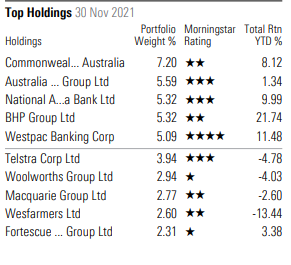
Realindex constructs a diversified, value-leaning portfolio. The strategy’s factors and price filters can lead to some differences relative to the more commonly used S&P/ASX 200 Accumulation Index. For example, the portfolio typically has lower price/book ratios and higher dividend yields. Realindex’s absolute weighting to most sectors remains relatively stable because the fundamental size characteristics tend not to fluctuate wildly unlike the sector weights fluctuation in market-cap benchmarks. Other deviations have been a historic tilt away from healthcare and real estate. Relative to the category index, S&P/ASX 200 Index, the strategy is value-focused and yield-oriented. Large-cap bias is apparent in the portfolio, but it is relative to the category average. As of November 2021, the portfolio was overweight in financial services and underweight in resources and healthcare. Realindex’s portfolio, traditionally, has remained quite similar to market-cap benchmarks overall. Historically, active share has hovered around 20%.

People
Realindex has been through a significant phase of transition in the past couple of years bought about by the end of the partnership with RAFI and the exit of a few senior portfolio managers. This has provided an opportunity for Realindex to revamp its overall team structure and bring on experienced investment professionals. The experienced David Walsh has joined as the head of investment, leading portfolio management and research, which Scott Hamilton leads. With the hires of Joana Nash and Ron Guido as experienced senior quant portfolio managers, Realindex has also beefed up its quant research capabilities.
The team is nimbler now for prioritization and effective collaboration on research initiatives and efficient implementation of the research outcomes, although it is preferred to have clearer lines between the research and portfolio management teams. The visible progress made in the trailing 18 months in research projects (for example, ESG factor impact on price and incorporating intangibles into the book value) augmenting the investment process through the implementation of novel signals is testimony of the team’s collective ability. The recent departure of experienced senior portfolio manager Raelene De Souza is unfortunate. Historically, Realindex has been successful in attracting top investment talent. But the length of their association with the firm has been shorter than it is prefered.


Performance
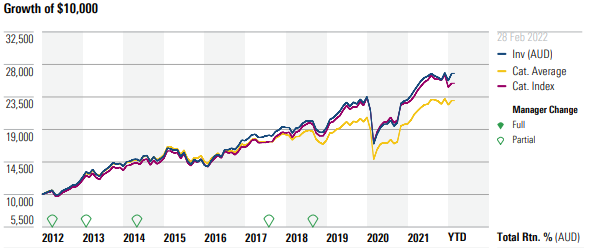
Realindex Australian Shares has delivered impressive peer-relative performance from inception through February 2022. Its five-year return of 8.5% per year as of February 2022 has easily outpaced the category average but only matched the broader market’s index return, indicating the tough environment it has been for value managers. This performance is principally attributed to the overweighting in materials, underweighting in healthcare, and energy. Better stock inclusion from the resources and consumer cyclical sectors has been additive too. Specifically, overweightings in BHP Group and Wesfarmers has added to performance and offset marginally by the overweighting in Westpac Banking. Amid the pandemic-induced uncertainties across the market, the strategy was admirably more resilient than the average category manager. The impressive outperformance was largely fueled by the strategy’s overweighting in materials, consumer cyclical, and consumer staples (a recurring theme across short- and long-term performance), although slightly offset by its overweighting in financial services. Over the trailing year through February 2022, the strategy has outperformed the S&P/ASX 200 Index but marginally stayed below the category average as value stocks have staged a reversal.

About Fund:
Realindex forms a universe of Australian companies based on accounting measures.Factors such as quality, near – term value and momentum are applied to form a final portfolio of companies. The resulting portfolio has a value tilt relative to the benchmark and provides the benefits of being lower in cost, lower turnover and highly diversified compared to traditional active investment strategies. Realindex overhauled its investment team with an aim to create a nimbler team structure and has hired investment professionals with a high skillset and experience level. The new team has made real progress in the trailing 18 months defining the research agenda and prioritizing projects in terms of their potential to value add. These developments paint a positive picture for the strategy; however, investors should note that the team’s tenure is short and Realindex’s track record in team turnover has not been impressive. As such, it is alleged for the investment team to exhibit longevity before experts’ conviction level is strengthened.

(Source: Morningstar)
General Advice Warning
Any advice/ information provided is general in nature only and does not take into account the personal financial situation, objectives or needs of any particular person.

Categories
Funds Funds Research Sectors

TIAA-CREF Core Plus Bond Fund Premier Class Bested Almost 70% Of Its Distinct Peers

Process:

Lead manager Joe Higgins continues the thoughtful relative value approach that has been in place both here and on his other charge, TIAA-CREF Core Bond TIBDX. This strategy earns an Above Average Process Pillar rating. Higgins has the ultimate authority in ensuring what holdings go into the portfolio but draws heavily on the strength and expertise offered by the sector managers, analysts, and macroeconomic strategists in identifying relative value opportunities across the fixed-income universe. The strategy can invest in everything from corporate bonds and mortgages to municipal bonds and emerging-markets debt, with the higher-risk sectors like high-yield bonds, bank loans, and emerging-markets debt ranging between 10% and 30% depending on the team’s outlook and risk appetite. The strategy has avoided taking extreme positions in any of those areas and has generated its alpha from a variety of sources instead of relying on any one area. This approach has benefited investors through steady-as-it-goes performance rather than wild swings based on drastic portfolio shifts, and it has worked through a variety of market environments. 

Portfolio:

As of December 2021, the portfolio’s largest exposures were to investment-grade corporate bonds (24.2% of assets), agency mortgage-backed securities (18.6%), and emerging-markets debt (10.2%). The emerging markets exposure rarely if ever broke double-digit threshold, but its allocation has been on the upswing since March 2020 given the portfolio managers’ belief in its ability to outperform over the long term. The emerging markets’ relative lack of direct correlation to domestic corporate moves, as well as premium on offer from new issuance, make them attractive. This overweighting also makes sense to the managers in context of a rising rate environment, as they seek refuge in assets that are not hypersensitive to rate increases. That 10.2% stake in emerging-markets debt is almost 4 times the category peer median, though, and about half of it is rated below-investment-grade. Coupled with 5.6% in high-yield corporates, 4.3% in nonagency mortgages, and 2.7% in senior loans, the “plus” sector exposure of this portfolio amounted to 22.7% at the end of December 2021. This edges toward the higher half of the 10%-30% “plus” budget and represents increased credit risk, but the strategy’s yield (a proxy for risk) has hugged quite closely to the peer median in the past couple of years, indicating a reasonable level of risk-taking.

People:

Joe Higgins, who replaced long time lead manager Bill Martin at the end of 2020, is a seasoned and capable manager supported by three experienced comanagers and a robust analyst team. The strategy earns an Above Average People Pillar rating. Higgins had been leading the Core strategy since 2011, has been with the firm since 1995, and was previously sector lead on asset-backed securities and commercial mortgage-backed securities. He is supported by the same trio of comanagers that backed Bill Martin: government specialist John Cerra, high-yield leader Kevin Lorenz, and emerging-markets expert Anupam Damani. They are backed by a robust investment team that continues to expand following the legacy Nuveen and Symphony merger. The organization now boasts considerable firepower, with 43 portfolio managers and 60 analysts spread across the fixed-income platform. Even though Higgins has the ultimate decision-making power for this strategy, he draws on the strength and expertise of the sector managers in allocating capital to portfolios per mandate requirements. As such, the whole team provides input to help with portfolio construction, and often the managers’ portfolios will rhyme with each other. Additionally, the introduction of an investment committee and strategy groups provided more formalized structures for manager discussions and viewpoint sharing.

Performance:

The strategy under Joe Higgins’ tenure has bested almost 70% of distinct peers in the intermediate core-plus bond category, keeping up with the record his predecessor Bill Martin set during his tenure from September 2011 to December 2020. Over that period, the Institutional share class returned 4.5% annualized and outpaced roughly two thirds of peers. While lagging performance punctuated this record at various points, most notably in March 2020, by and large “measured consistency” was the characteristic on display for this strategy’s performance. Following the rough showing in early 2020 when the strategy lost 8%, almost 200 basis points more than the peer group median, the strategy experienced more bumps all throughout 2021 as rate volatility had a negative impact on mortgage holdings. On the plus side, the strategy had an underweighting in agency mortgages relative to the benchmark (18.6% versus 27.4% at year-end) so the hit was less severe, and an overweighting in high-yield corporates relative to the bogy (5.6% versus 0%) proved rewarding given robust economic conditions.

Graphical user interface, table

Description automatically generated

(Source: Morningstar)

Price:

It’s critical to evaluate expenses, as they come directly out of returns. The share class on this report levies a fee that ranks in its Morningstar category’s cheapest quintile. Based on our assessment of the fund’s People, Process and Parent pillars in the context of these fees, we think this share class will be able to deliver positive alpha relative to the category benchmark index, explaining its Morningstar Analyst Rating of Bronze.

Table

Description automatically generated

(Source : Morningstar)

About Funds:

TIAA-CREF Core Plus Bond has an experienced lead manager and the solid process remains intact, while the expansive supporting cast has only broadened. The strategy’s Institutional and Advisor share classes earn a Morningstar Analyst Rating of Silver, while the more-expensive share classes are rated Bronze. The W share class, which does not charge a fee, is unrated. Veteran manager Joe Higgins, who has led the sibling strategy TIAA-CREF Core Bond TIBDX since 2011, took over this strategy at the end of 2020 when long time lead manager Bill Martin retired. Higgins was a natural replacement given that he had been running a similar, more-conservative mandate. He is supported by the same trio of comanagers that backed Martin: government specialist John Cerra, high-yield leader Kevin Lorenz, and emerging-markets expert Anupam Damani. All told, Nuveen’s robust taxable fixed-income group boasts more than 100 portfolio managers, analysts, and traders that help Higgins fulfil his mandate. The strategy’s solid process remains unchanged and peppered with measured risk-taking. Higgins and team execute a relative value process that incorporates a broad opportunity set, with the bulk of assets in investment-grade securities and a smaller subset in higher-risk “plus” sectors like high-yield bonds, bank loans, and emerging-markets debt that will typically amount to 10%-30% of assets depending on Higgins’ outlook and allocation decisions. 

(Source: Morningstar)

General Advice Warning

Any advice/ information provided is general in nature only and does not take into account the personal financial situation, objectives or needs of any particular person.

Categories
Funds Funds

Fidelity Sustainable Asia Equity Fund W-Accumulation (UK): Top Picks Among Asian Equity Offerings

Approach

This UK vehicle has formally adopted a sustainability mandate since April 2021. The investment process starts with hard exclusions, which contains firms with material exposure to weapons, tobacco, coal miners, and oil/gas extraction, among others. The exclusion list was further extended in 2021 to include oil/gas/ nuclear power utilities and firms that the team marked to have “deteriorating” ESG momentum within their sustainability rating framework, but it still accounted for less than 5% of the MSCI AC Asia ex Japan Index, and it hasn’t been seen  trigger any material changes to the portfolio over the past year. Dhananjay Phadnis has long favoured quality companies run by strong management teams that can demonstrate cinsistent value creation. It is considered the adoption of a sustainability framework a formalisation of the approach that he has already employed rather than a material change. Phadnis focuses on a firm’s competitive advantages, management quality, potential for improvement on ESG practice, and valuations in stock selection. The end portfolio consists of 50-70 names, which typically are fundamentally sound businesses trading below their intrinsic values and out-of-favour stocks with turnaround catalysts. Sector and country allocations are a residual of stock selection, though weights must stay within 10 percentage points of the index. Phadnis has done an excellent job extracting performance out of the strategy’s risk budget, and his investment savvy brings a further edge to the approach’s execution. Overall, the strategy maintains Process rating of High.

Portfolio

Dhananjay Phadnis increased the portfolio’s exposure to financials to 28.1% as of December 2021 from 19.3% a year ago, which represented a 9.4% overweighting compared with the MSCI AC Asia ex Japan Index. He added to AIA, despite it being a major underperformer in 2021. At Analysts’ January 2022 meeting, Phadnis remained positive on the insurer’s growth outlook, noting that it managed to expand its agent head count and branch out into new provinces in China when other Chinese insurers experienced difficulties in maintaining their agency force in 2021. Conversely, his conviction in Ping An Insurance waned given its slower-than-expected agency reform and its questionable decision of buying a majority stake in bankrupt Founder Group, and he has therefore exited his position. Meanwhile, the December 2021 portfolio continued to have an overweight position in information technology, where its 27.3% stake was above the index’s 25.8%. Phadnis liked SK Hynix, believing that the chipmaker’s acquisition of Intel’s NAND unit will enhance its competitiveness in the global memory market and that it has better corporate governance among Korean companies. Within consumer discretionary (16.1%), Phadnis initiated a stake in Meituan in July 2021 when its valuation became more compelling amid the regulatory crackdown. He believed the food delivery giant’s business model can adapt to new regulatory standards, noting its pricing power and efficient delivery network in the segment.

People

Dhananjay Phadnis brings 20 years of investment experience and has led this strategy’s UK and Luxembourg-domiciled vehicles since November 2013 and March 2015, respectively. He joined Fidelity in 2004 as an analyst and covered a variety of sectors before being promoted to portfolio manager in 2008. He has since posted excellent results across the single-country and regional mandates under his management, though he now focuses on this sustainable Asia equity strategy, which includes the USD 1.2 billion, Luxembourg-domiciled Fidelity Asian Equity fund that Phadnis took over from former manager Suranjan Mukherjee in August 2021. Phadnis had a total AUM of USD 6.1 billion as of December 2021. It is alleged Phadnis is one of the best Asian equity managers, who has consistently showcased astute investment savvy and a great passion for investing. Director of sustainable investing Flora Wang has been the strategy’s assistant portfolio manager since February 2021, when it formally adopted a sustainability mandate. Most of Wang’s contributions currently lie in the ESG integration front, including engaging with companies and identifying materiality issues. She is also gradually developing her fundamental stock-picking skills under Phadnis’ mentorship, and it is monitored how her role evolves. Phadnis is supported by Fidelity’s deep Asia Pacific ex Japan team of 58 analysts who average nine years of experience and six years with Fidelity. The team has showed greater stability since 2020 and has further grown with six additions in 2021 through September. Overall, the strategy continues to merit a People rating of High.

Performance 

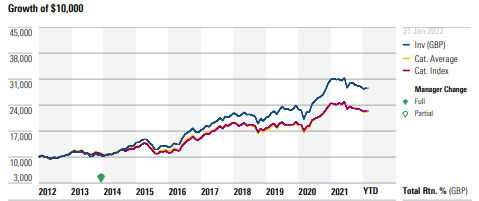
Lead manager Dhananjay Phadnis has delivered excellent results since he took over the UK-domiciled vehicle in November 2013. Through 31 Jan 2022, the W Acc share class returned 12.3% per year (in pound sterling), beating the MSCI AC Asia ex Japan Index’s 8.57% gain, the MSCI Emerging Markets Asia Index’s 8.86% gain, and 96% of its Asia ex Japan equity category peers. Its standard deviation was slightly higher than the indexes but in line with typical peers, resulting in robust risk-adjusted results. Indeed, the share class’ Sharpe ratio of 0.58 during the same period outpaced both indexes and 97% of peers. The outperformance was primarily driven by strong stock selection in China and India, with consumer discretionary, communication services, and financials contributing from a sector perspective. 

Phadnis’ quality bias and prudent risk management helped buoy the strategy’s relative performance in the 2021 down market. Although the W Acc share class lost 3.2% last year, it outperformed the MSCI AC Asia ex Japan Index by 64 basis points and ranked in the 48th percentile among peers. The vehicle primarily benefited from solid stock picks in the communication services and industrials sectors, with Bharti Airtel, NAVER, and Titan Wind Energy being some of the top contributors. The underweightings in Alibaba and Tencent and not owning Pinduoduo also helped, as they plunged on the back of heightened regulatory crackdowns in 2021. Conversely, stock picks in financials and healthcare detracted.

About Fund:

Fidelity International Limited is mainly owned by management and members of the Johnson family, who founded US-based Fidelity Investments. The entities have been separate since 1980, and though there are some similarities, in practice there is only limited alignment between the two. There were a number of personnel changes in 2018-19, including a change in CEO and the CIOs of equities, fixed-income, and multiasset, but the composition of senior management has been relatively stable since. More important, these changes do not seem to have negatively affected day-to-day investment activities, and on the whole, the initiatives undertaken by new management seem sensible.

(Source: Morningstar)

General Advice Warning

Any advice/ information provided is general in nature only and does not take into account the personal financial situation, objectives or needs of any particular person.

Categories
Funds Funds

Vanguard LifeStrategy Conservative Growth Fund Investor Shares: Broadly Diversified, Low-Cost, And Effective

Approach

Vanguard’s efficient, low-cost method provides series’ investors with broad market exposure. The sensible and well-executed approach earns a renewed Above Average Process rating. The equity exposure of the four funds in the lineup (Vanguard LifeStrategy Income VASIX, Vanguard LifeStrategy Conservative Growth VSCGX, Vanguard LifeStrategy Moderate Growth VSMGX, and Vanguard LifeStrategy Growth VASGX) is 20%, 40%, 60%, and 80%, respectively. Vanguard’s strategic asset allocation committee and the investment strategy group provide oversight for the fund series. On an annual basis, the committee reviews the allocations, leveraging research produced by the investment strategy group. The committee takes a cautious tack, which results in a relatively modest approach to implementation changes. Prior to 2011, the series included an allocation to a tactical asset allocation strategy, but that piece was removed, resulting in an exclusively passive underlying fund lineup and strictly strategic procedure. International bond exposure was introduced to the series in 2013, and in 2015 international exposure was increased within both the equity and the fixed-income sleeves: non-U.S. stock exposure increased to 40% from 30% and non-U.S. bond exposure increased to 30% from 20%. The firm’s research suggests that a market-cap weighted approach delivers broad exposure and effectively diversifies the funds but cites investors’ home-country preferences.

Portfolio

As of early 2022, the strategies comprising each portfolio receive compelling ratings. The series’ equity sleeves hold Silver-rated Vanguard Total Stock Market Index VTSMX and Gold-rated Vanguard Total International Stock Index VGTSX. On the fixed-income side, the funds tap Vanguard Total Bond Market II Index VTBIX and Vanguard Total International Bond Index VTIBX, both rated Bronze. The latest addition, Vanguard Total International Bond Index II VTIIX, was launched in February 2021 as a clone of Vanguard Total International Bond Index. The fund is exclusively used in the LifeStrategy and the target retirement series, allowing Vanguard to separate transaction costs generated by the massive target retirement series and LifeStrategy from those generated by other investors. Managers began transitioning the international bond exposure to the clone fund in March 2021 and will continue to do so in a tax-sensitive manner. In the wake of a volatile early 2020, the firm updated the threshold rebalancing policy for multi-asset strategies. Prior to 2021, the rebalancing policy stipulated allocation guardrails of 75 basis points; if exceeded, managers rebalanced the allocations to within 50 basis points of the benchmark. As of Jan. 1, 2021, the new guardrails sat at 200 basis points; if exceeded, managers rebalanced the portfolios to within 100 basis points of the target allocations. This change is reasonable and should reduce the strategy’s rebalancing frequency as intended. 

People

Experienced leadership, a multigroup approach, and robust teams across Vanguard merit a renewed Above Average People rating. The LifeStrategy series is managed by the same teams that oversee the firm’s target retirement funds. Vanguard’s strategic asset allocation committee is responsible for ongoing oversight of multi-asset funds. The committee’s 10 voting members include senior leaders across the firm, such as its global chief economist, who also serves as the committee chair. The strategic asset allocation committee is supported by the firm’s investment strategy group, which is composed of a global network of more than 70 investment professionals. Their research covers an array of topics ranging from investor behavior to portfolio construction. Management of the underlying index funds remains stable and well-resourced. Gerard O’Reilly and Walter Nejman manage the U.S. equity index fund, while Michael Perre and Christine D. Franquin cover the international counterpart. O’Reilly and Perre each have roughly three decades of tenure at Vanguard. Franquin and Nejman have spent 21 and 16 years at Vanguard, respectively. Fixed-income manager Joshua Barrickman joined the firm in 1998 and assumed the role of head of fixed-income indexing in the Americas in 2013. Barrickman manages both the domestic and international bond strategies.

Performance 

Over the trailing 10 years ended January 2022, three of the four funds outperformed their target risk Morningstar Category benchmarks and their allocation fund category peer medians in total annualized returns, respectively. The Moderate Growth fund was the exception: it managed to outpace its Morningstar Moderate Target Risk Index category benchmark but underperformed the typical peer in the competitive allocation — 50% to 70% equity category. On a risk-adjusted basis (as measured by Sharpe ratio) over the same period, all four portfolios outperformed their category benchmarks and their average peer constituent. Notably, the two most conservative funds of the series both landed in the best performing deciles of their respective category peer groups while the most risk-tolerant fund landed in the best performing quintile of the allocation — 70% to 85% equity category group. 

The series’ bond sleeves have a higher duration profile relative to peers, which results in greater sensitivity to changes in interest rates. The recent low-yield environment and threat of rising rates presented a challenge to the profiles here, and for the one-year return ended January 2022, all four portfolios underperformed their respective category peer averages and three of the four underperformed their respective category benchmarks. Only the Growth fund outpaced its Morningstar Moderate Aggressive Target Risk Index category benchmark in that period.

About Fund:

The Vanguard Group earns a High Parent rating for its investor-centric ethos, reliable strategies, and democratization of advice. Vanguard is the asset-management industry’s only client-owned firm, and it shows. Vanguard uses the money that its passive strategies make from securities lending to lower if not eliminate headline expense ratios. Modest fees, capable subadvisors, and performance incentives spur its active business to competitive results. Vanguard also offers advice, human and digital, at an accessible cost. All of this helped its global assets under management grow to USD 7.5 trillion as of March 31, 2021. Yet, Vanguard’s non-U.S. business only accounts for a fraction of its assets. Incumbents within many of these markets have sought to keep this low-cost provider at bay. Vanguard has shifted from leading with exchange-traded funds to using advice for entry, such as its joint venture with China’s Ant Financial to offer a mobile-based retail service, which had more than 1 million Chinese users a year after its April 2020 launch. 

(Source: Morningstar)

General Advice Warning

Any advice/ information provided is general in nature only and does not take into account the personal financial situation, objectives or needs of any particular person.

Categories
Funds Funds

Vanguard Real Estate Index Fund Investor Shares: Low cost, no-frills U.S real estate exposure

Approach

Tracking the MSCI U.S. Investable Market Real Estate 25/50 Index yields a broadly diversified portfolio that captures the full scope of opportunities available to U.S. real estate investors. Market-cap weighting channels the market’s collective wisdom and promotes low turnover, underpinning an Above Average Process Pillar rating. This index selects stocks from the MSCI U.S. Investable Market Index, a broad benchmark the spans the complete U.S. stock market. It adds firms that are classified under the real estate sector. This includes equity REITs as well as real estate management and development firms. The fund excludes mortgage and hybrid REITs, which partially derive their revenue through real estate lending.

Portfolio

REITs represent 96% of this portfolio, with real estate management and development firms rounding out the remainder. REITs are required to distribute at least 90% of their taxable income to shareholders, so this fund consistently generates higher yield than the category average. REITs tend to be more sensitive to interest rates than other equity sectors, partially because interest rates directly affect property values. Additionally, their cash flows from rent collection are relatively fixed, making them somewhat bondlike. REITs’ interest-rate sensitivity depends on their lease durations. For example, office REITs (11% of portfolio) tend to be quite sensitive because of their longer lease cycles, but the shorter leases of residential REITs (14%) make them less responsive. Industrial (11%) and retail REITs (9%) tend to fall in the middle. This fund sprinkles investment across an array of property types, ensuring that its fate isn’t tied to a bet on interest rates or one industry’s performance. 

Performance

Specialty REITs have fared very well over the past few years. REITs that own and operate cell towers, like Crown Castle International CC and American Tower ATC, have turned in especially strong performance. This fund invests in specialty REITs more heavily than the category average, so it has reaped strong growth from these sound performers. Specialty REITs tend to be more volatile than other property types, but they have also demonstrated the potential for stronger returns. 

About the Fund

The investment seeks to provide a high level of income and moderate long-term capital appreciation by tracking the performance of the MSCI US Investable Market Real Estate 25/50 Index that measures the performance of publicly traded equity REITs and other real estate-related investments. The advisor attempts to track the index by investing all, or substantially all, of its assets-either directly or indirectly through a wholly owned subsidiary, which is itself a registered investment company-in the stocks that make up the index, holding each stock in approximately the same proportion as its weighting in the index. The fund is non-diversified.

(Source: Morningstar)

General Advice Warning

Any advice/ information provided is general in nature only and does not take into account the personal financial situation, objectives or needs of any particular person.

Categories
Funds Funds

One of the cheapest funds tracking the broadly diversified S&P 500.

Investment Objective

Vanguard 500 Index Fund seeks to track the performance of a benchmark index that measures the investment return of large-capitalization stocks.

Approach

This broadly diversified portfolio is representative of the opportunity set in the large-blend category. It relies on the market’s collective wisdom to size its positions and enjoys low turnover as a result. It earns a High Process Pillar rating. The index pulls in stocks of the largest 500 U.S. companies that pass its market-cap, liquidity, and profitability screens.An index committee selects constituents from this eligible universe, allowing for more flexibility around index changes compared with more-rigid rules based indexes. The index committee aims to avoid unnecessary turnover, and it reconstitutes the index on an as-needed basis. The committee may temporarily deviate from these rules. It may not delete existing constituents that violate eligibility criteria until an addition to the index is warranted.The portfolio managers reinvest dividends as they are paid and use derivatives to equitize cash and keep pace with the benchmark. They have also historically used securities lending to generate additional income for the fund, which has helped tighten the fund’s tracking difference and make up for some of its annual expense ratio.

Portfolio 

Market-cap weighting allows the fund to harness the market’s collective view of each stock’s relative value, and it keeps turnover low. As of January 2022, stocks representing around 90% of the portfolio enjoy either a narrow or wide Morningstar Economic Moat Rating. This weighting scheme pushes the work of sizing positions onto the market. Over the long term, this has been a winning proposition. But the market has manic episodes from time to time. Over shorter time frames, investors’ enthusiasm for a particular stock or sector can make the portfolio top-heavy as it tilts toward recent winners. This has been the case with technology stocks in recent years. The portfolio’s top 10 holdings represented approximately 29% of its assets as of January 2022, higher than its historical average but much lower than the category average. Nonetheless, the fund is still representative of the opportunity set available to its actively managed peers in the large-blend category, and its sector and style characteristics are similar to the category average. As of December 2021, the fund was slightly overweight in tech stocks and made up the difference with a smaller allocation to industrials.

Performance 

From its inception in 2010 through January 2022, the exchange-traded share class outperformed the category average by 2.35 percentage points annualized. Its annual returns consistently ranked in the category’s better-performing half. The fund’s risk-adjusted returns also held up well against category peers, while its Sharpe ratio maintained a top-quartile ranking in the category over the trailing one-, three-, five-, and 10-year periods. Most of this outperformance can be attributed to its low cash drag and competitive expense ratio.

The portfolio tends to perform as well as its category peers during downturns while outperforming during market rallies. It captured 96% of the category average’s downside and 106% of its upside during the trailing 10 years ending in 2022. During the initial coronavirus-driven shock from Feb. 19 to March 23, 2020, the fund outperformed the category average by 9 basis points. It then bounced back faster than peers during the recovery phase from late March through December 2020, gaining 3.29 percentage points more than the category average. 

Tracking performance has been solid. Over the trailing one-, three-, five-, and 10-year periods ended January 2022, the fund trailed the S&P 500 by an amount approximating its annual expense ratio.

Top 10 Holdings

About the fund

The fund employs a “passive management”—or indexing—investment approach designed to track the performance of the Standard & Poor’s 500 Index, a widely recognized benchmark of U.S. stock market performance that is dominated by the stocks of large U.S. companies. The fund attempts to replicate the target index by investing all, or substantially all, of its assets in the stocks that make up the index, holding each stock in approximately the same proportion as its weighting in the index. The 500 Index Fund is a low-cost way to gain diversified exposure to the U.S. equity market. The key risk for the fund is the volatility that comes with its full exposure to the stock market. Because the 500 Index Fund is broadly diversified within the large-capitalization market, it may be considered a core equity holding in a portfolio.

(Source: Morningstar)

General Advice Warning

Any advice/ information provided is general in nature only and does not take into account the personal financial situation, objectives or needs of any particular person.

Categories
Funds Funds

Neuberger Berman International Equity Fund Investor Class

Process:

This strategy’s distinctive approach remains in place under its new leader, earning it an Above Average Process rating. Former lead manager Benjamin Segal said he favoured the mid-cap universe because firms of that size–along with those in the smaller part of the large-cap range–tend to be well-enough established that they can withstand some setbacks but remain less familiar to many global investors and thus often sell at attractive prices. They can also be takeover targets. Former comanager Elias Cohen, who became lead manager upon Segal’s departure on June 30, 2021, follows the same approach. This team wants steadily growing firms, but it also focuses on the quality of company management. The team is willing to own firms without hefty margins if other traits are impressive. The strategy has a 15% limit on emerging-markets exposure, but the portfolio has been far below that for a long time. The turnover rate tends to be moderate. Ideas can come from Cohen, comanager Tom Hogan, or the analysts, and decision-making is collaborative, though the lead manager has final authority for portfolio decisions.

Portfolio:

Portfolio shows that this fund makes fuller use of the market-cap spectrum than most peers and its chosen benchmark, the MSCI EAFE Index. The fund had about 33% of its assets in midcaps and another 4% in small caps (as classified by Morningstar), versus just 10% in mid-caps and almost nothing in small caps for the index and just slightly higher figures for the foreign large-growth and foreign large-blend category averages. The portfolio’s figures are nearly identical to those from one year earlier, showing that new lead manager Elias Cohen has maintained the strategy’s broad market-cap approach even as he traded several stocks into and out of the portfolio. Cohen, like former manager Benjamin Segal, favours the mid-cap and smaller large-cap universes. The portfolio often lies on the border between the growth and blend portions of the style box, but the latest portfolio is fully in the blend region. The strategy continues to spread its assets widely, with none of the 78 stocks receiving more than 2.6% of assets. Emerging-markets exposure remains below 5% and is limited to China and India.

People:

This strategy’s long-tenured lead manager, Benjamin Segal, left Neuberger Berman on June 30, 2021, to become a high school math teacher. Replacing him as lead manager was former comanager Elias Cohen. The firm had earlier promoted Thomas Hogan from the analyst ranks to comanager on Jan. 20, 2021. Cohen had worked with Segal for almost 20 years, most recently as comanager–for two years on this strategy and four years on sibling Neuberger Berman International Select NILIX. The analyst staff remained intact including one addition in March 2021. Three of the six members of the analyst team have been in place since 2008 or earlier. They and the managers also talk with the members of Neuberger Berman’s emerging-markets team. Cohen and Hogan each have more than $1 million invested in this strategy.

Performance:

It’s a bit complicated assessing this fund’s performance, but all in all, the fund has a solid record as a core international equity choice. This fund launched in 2005 and was known until late 2012 as Neuberger Berman International Institutional. But an identical fund that was merged into it in January 2013 posted a strong 10-year record prior to the merger, using the same strategy, under recently departed lead manager Benjamin Segal. Another complication is that although this fund’s growth leanings result in its placement in the foreign large-growth category, it is not very aggressive in that direction, with its portfolio often landing around the border between growth and blend or, as currently, in the blend box. That’s typically been a disadvantage versus growthier rivals for a long time. The managers aim to outperform when markets tumble; although it did not do so in the bear market of early 2020, it did hold up well during the 2014 sell-off and the 2015-16 bear market.

(Source: Morningstar)

Price:

It’s critical to evaluate expenses, as they come directly out of returns. The share class on this report levies a fee that ranks in its Morningstar category’s second-costliest quintile. That’s poor, but based on our assessment of the fund’s People, Process and Parent pillars in the context of these fees, we still think this share class will be able to overcome its high fees and deliver positive alpha relative to the category benchmark index, explaining its Morningstar Analyst Rating of Bronze.

Top Portfolio Holdings:  
Asset Allocation:  


(Source: Morningstar)                                                                     (Source: Morningstar)

About Funds:

A growing conviction in the duo that manages JPMorgan U.S. Large Cap Core Plus and its Luxembourg resided sibling JPM U.S. Select Equity Plus, and the considerable resources they have effectively utilised, lead to an upgrade of the strategy’s People Pillar rating to Above Average from Average. The strategy looks sensible and is designed to fully exploit the analyst recommendations by taking long positions in top-ranked companies while shorting stocks disliked by the analysts. Classic fundamental bottom-up research should give the fund an informational advantage. The portfolio is quite diversified, holding 250-350 stocks in total with modest deviations from the category index in the long leg. The 30/30 extension is broadly sector-, style-, and beta-neutral. Here the managers are cognizant of the risks of shorting stocks, where they select stocks on company-specific grounds or as part of a secular theme. For example, the team prefers semiconductors, digital advertising, and e-commerce offset by shorts in legacy hardware, media, and network providers. Short exposure generally stands at 20%-30%, with the portfolio’s net exposure to the market kept at 100%. The strategy’s performance since inception, which still has some relevance given Bao’s involvement, has been outstanding.

(Source: Morningstar)

General Advice Warning

Any advice/ information provided is general in nature only and does not take into account the personal financial situation, objectives or needs of any particular person.