Categories
Dividend Stocks

Halma Plc – The Board increased the final Dividend by +7%, equating to +7% y/y increase in total Dividend

Investment Thesis:

  • High quality company with a history of earnings and dividend growth.
  • Management is looking to double EPS every five years. HLMA’s group earnings growth model is driven by organic and acquired growth. 
  • HLMA earnings are defensive as HLMA is exposed to attractive end markets which are niche and regulated in some shape or form – such as safety, medical and infrastructure.
  • HLMA consists of a strong diversified portfolio of companies (currently 45 companies). 
  • Strong management team with strong corporate culture. 
  • “Private Equity firm with a purpose” – the Company is not limited by a timeframe to exit positions. 
  • HLMA operates a decentralized operating structure with operating companies and management teams left to run their businesses. 
  • Scores well on ESG metrics – targeting a science-based emission target (1.5 degree-aligned 2030 target for Scope 1 & 2 emissions), a net zero target (scope 1 & 2 by 2040) and transitioning towards a circular economy.

Key Risks:

  • Execution risk – specifically around acquired growth or the inability to source enough deals as the group grows larger.
  • Deterioration in global growth or consumption.
  • New CEO represents opportunity and risk (strategic misstep).

Key Highlights:

  • The Board increased the final dividend by +7% to 11.53p, which combined with interim dividend of 7.35p per share, resulted in a total dividend of 18.88p, up 7% y/y. This was the 43rd consecutive year of dividend per share growth of +5% or more. Net debt (on an IFRS 16 basis which includes lease commitments) increased +7% y/y to £274.8m and represents gearing (net debt to EBITDA) of 0.74x times, within operating range of <2x. HLMA has ample liquidity – refinancing GBP 550m syndicated revolving credit facility (matures in May 2027), completion of a new Private Placement issuance of GBP 330m, with a seven-year average life and additional funding capacity of GBP 260m on maturing of January 2023 tranche of existing Private Placement.
  • Organic revenue growth (in CC) in single digit percentage. 
  • Return on Sales similar to 2H22 of 20.5%.
  • Capex to increase +26% y/y to ~GBP 34m, reflecting a more normal level of spend relative to the increased size of the group, with investment largely focused on the expansion and automation of manufacturing facilities to support future growth, with investment of GBP 20m in Group-wide technology (vs GBP 11m in pcp) primarily focused on delivering enhanced security, improved data and analytics capabilities, and support for companies in upgrading their operating technology and creating new digital models. 
  • Central costs to increase +29% y/y to GBP 40m. 
  • Net financing cost (assuming no further acquisitions are made) to increase +67% y/y to GBP 14m, reflecting a higher weighted average interest rate in the year.
  • Strong FX tailwinds (assuming currency rates for FY23 of USD 1.260/ Euro 1.190 relative to GBP) of GBP 59m on revenue and GBP 13m on profit, with the majority of impact in 1H23. 

Company Description:

Halma Plc (HLMA), listed on the London Stock Exchange, looks to acquire, and grow businesses in niche markets with a global reach. The Company focuses on markets such as medical, safety and environment. Management believes the earnings profile of these markets have a high degree of defensibility and long-term growth drivers. The Company is not like a Private Equity firm which looks to acquire businesses, reduce costs (to improve earnings profile) and then sell within a 5-year timeframe. HLMA looks to buy and hold companies over the long-term. They manage the mix of businesses in a group portfolio to drive sustainable growth and returns over the long term. HLMA looks to acquire businesses to accelerate penetration of more markets, merge businesses where it markets sense, and exit markets if they become less attractive from a long-term growth and returns perspective.  

(Source: Banyantree)

DISCLAIMER for General Advice: (This document is for general advice only).

This document is provided by Laverne Securities Pty Ltd T/as Laverne Investing. Laverne Securities Pty Ltd, CAR 001269781 of Laverne Capital Pty Ltd AFSL No. 482937.

The material in this document may contain general advice or recommendations which, while believed to be accurate at the time of publication, are not appropriate for all persons or accounts. This document does not purport to contain all the information that a prospective investor may require.  The material contained in this document does not take into consideration an investor’s objectives, financial situation or needs. Before acting on the advice, investors should consider the appropriateness of the advice, having regard to the investor’s objectives, financial situation, and needs. The material contained in this document is for sales purposes. The material contained in this document is for information purposes only and is not an offer, solicitation or recommendation with respect to the subscription for, purchase or sale of securities or financial products and neither or anything in it shall form the basis of any contract or commitment. This document should not be regarded by recipients as a substitute for the exercise of their own judgment and recipients should seek independent advice.

The material in this document has been obtained from sources believed to be true but neither Laverne and Banyan Tree nor its associates make any recommendation or warranty concerning the accuracy or reliability or completeness of the information or the performance of the companies referred to in this document. Past performance is not indicative of future performance. Any opinions and or recommendations expressed in this material are subject to change without notice and, Laverne and Banyan Tree are not under any obligation to update or keep current the information contained herein. References made to third parties are based on information believed to be reliable but are not guaranteed as being accurate.

Laverne and Banyan Tree and its respective officers may have an interest in the securities or derivatives of any entities referred to in this material. Laverne and Banyan Tree do and seek to do business with companies that are the subject of its research reports. The analyst(s) hereby certify that all the views expressed in this report accurately reflect their personal views about the subject investment theme and/or company securities.

Although every attempt has been made to verify the accuracy of the information contained in the document, liability for any errors or omissions (except any statutory liability which cannot be excluded) is specifically excluded by Laverne and Banyan Tree, its associates, officers, directors, employees, and agents.  Except for any liability which cannot be excluded, Laverne and Banyan Tree, its directors, employees and agents accept no liability or responsibility for any loss or damage of any kind, direct or indirect, arising out of the use of all or any part of this material.  Recipients of this document agree in advance that Laverne and Banyan Tree are not liable to recipients in any matters whatsoever otherwise; recipients should disregard, destroy or delete this document. All information is correct at the time of publication. Laverne and Banyan Tree do not guarantee reliability and accuracy of the material contained in this document and are not liable for any unintentional errors in the document.

The securities of any company(ies) mentioned in this document may not be eligible for sale in all jurisdictions or to all categories of investors. This document is provided to the recipient only and is not to be distributed to third parties without the prior consent of Laverne and Banyan Tree.

Categories
Global stocks

Swatch-owned brands account for around 35% of Swiss watch exports

Business Strategy & Outlook

The Swatch Group is the biggest vertically integrated Swiss watch manufacturer with 18 brands covering all price ranges, from entry to ultra luxury. Swatch-owned brands account for around 35% of Swiss watch exports, and the company supplies competitors with watch movements. Swatch Group’s luxury brands boast 100- to 200-year histories, iconic collections, and deep cultural heritage. Most of Swatch’s brands (at price points below $10,000) benefit from a cost advantage through scale and a higher degree of production automation.

Swatch’s diversification in terms of brands and price points helps it to avoid the pitfalls that come with extending brands into categories where they don’t strategically belong, and to potentially capture positive mix as consumers trade up. However, a lack of control over distribution (around 70% of sales are wholesale) as a weak spot for the company. Distributors are more likely to engage in discounting to maintain cash flows when demand sours, which can be damaging for brands with long shelf-life products. The recent strong supply response from Swatch and its competitors to Chinese demand points to a lack of supply discipline. The supply discipline is one of the important moat-supporting factors for luxury brands, as it helps to preserve the brand exclusivity perception and ensure high returns on capital. The Swatch Group’s sales to grow at a 4.3% pace over the long term (versus low -single-digit growth over the prior decade) with mid-single-digit growth for its higher-priced watch brands such as Omega, Longines, Breguet and Blancpain, high-single-digit growth for jewelry brand Harry Winston and flat revenue for low-end watches (Tissot, Swatch, Mido, Hamilton and so on).

Financial Strengths

Swatch is in a strong financial position with CHF 2.5 billion in net cash at the end of 2020, with minimal financial debt and around CHF 2.6 billion in cash and marketable securities on the balance sheet. Further, over one third of inventories of Swatch Group, or over CHF 2.1 billion by value, are in precious metals and stones, recorded both in raw materials and as part of finished and semi finished goods. It is well-positioned to weather the COVID-19 crisis. Given the industry’s cyclicality, the financial prudence is appropriate. Cash flow improvement in future through operating leverage on fixed costs, cost discipline in the company—and especially within underperforming brands—and lower investment levels as productive and retail capacity has been built out in the past upcycle years. The free cash flow margin at around 10%, approximately in line with 2020-21 levels, as the investment cycle rolls over. The Swatch to remain mostly equity financed with low financial leverage.

Bulls Say

  • Around three quarters of Swatch’s revenue and higher share of profits are from higher-end watch and jewelry brands, not directly affected by smartwatch competition.
  • Harry Winston, among the few global brands in luxury jewelry, a niche with especially high entry barriers, offers growth and margin expansion potential. 
  • Swatch is increasingly taking action to tackle costs in low-end brands and limit gray market channels for high-end brands.

Company Description

Swatch Group’s biggest brands are Omega (number-two Swiss watch brand by sales after Rolex), Longines (the largest premium watch brand and number four by sales globally), Breguet, Tissot (the leader in mid range Swiss watches), and Swatch. Swatch group employs over 31,000 people, half of them in Switzerland. The Swatch Group makes about 28% of its sales from Omega, 18% from ultra luxury brands, 20% from Longines, 12% from Tissot, and 4% from Swatch. The Omega and Longines to be the group’s most profitable brands.

(Source: Morningstar)

DISCLAIMER for General Advice: (This document is for general advice only).

This document is provided by Laverne Securities Pty Ltd T/as Laverne Investing. Laverne Securities Pty Ltd, CAR 001269781 of Laverne Capital Pty Ltd AFSL No. 482937.

The material in this document may contain general advice or recommendations which, while believed to be accurate at the time of publication, are not appropriate for all persons or accounts. This document does not purport to contain all the information that a prospective investor may require.  The material contained in this document does not take into consideration an investor’s objectives, financial situation or needs. Before acting on the advice, investors should consider the appropriateness of the advice, having regard to the investor’s objectives, financial situation, and needs. The material contained in this document is for sales purposes. The material contained in this document is for information purposes only and is not an offer, solicitation or recommendation with respect to the subscription for, purchase or sale of securities or financial products and neither or anything in it shall form the basis of any contract or commitment. This document should not be regarded by recipients as a substitute for the exercise of their own judgment and recipients should seek independent advice.

The material in this document has been obtained from sources believed to be true but neither Laverne and Banyan Tree nor its associates make any recommendation or warranty concerning the accuracy or reliability or completeness of the information or the performance of the companies referred to in this document. Past performance is not indicative of future performance. Any opinions and or recommendations expressed in this material are subject to change without notice and, Laverne and Banyan Tree are not under any obligation to update or keep current the information contained herein. References made to third parties are based on information believed to be reliable but are not guaranteed as being accurate.

Laverne and Banyan Tree and its respective officers may have an interest in the securities or derivatives of any entities referred to in this material. Laverne and Banyan Tree do and seek to do business with companies that are the subject of its research reports. The analyst(s) hereby certify that all the views expressed in this report accurately reflect their personal views about the subject investment theme and/or company securities.

Although every attempt has been made to verify the accuracy of the information contained in the document, liability for any errors or omissions (except any statutory liability which cannot be excluded) is specifically excluded by Laverne and Banyan Tree, its associates, officers, directors, employees, and agents.  Except for any liability which cannot be excluded, Laverne and Banyan Tree, its directors, employees and agents accept no liability or responsibility for any loss or damage of any kind, direct or indirect, arising out of the use of all or any part of this material.  Recipients of this document agree in advance that Laverne and Banyan Tree are not liable to recipients in any matters whatsoever otherwise; recipients should disregard, destroy or delete this document. All information is correct at the time of publication. Laverne and Banyan Tree do not guarantee reliability and accuracy of the material contained in this document and are not liable for any unintentional errors in the document.

The securities of any company(ies) mentioned in this document may not be eligible for sale in all jurisdictions or to all categories of investors. This document is provided to the recipient only and is not to be distributed to third parties without the prior consent of Laverne and Banyan Tree.

Categories
Technology Stocks

ORCL’s cloud ERP has the potential to become the market leader

Investment Thesis

  • Industry leader with a solid portfolio and proven track record in achieving solid profitability and leading high and improving margins. ORCL has a large global footprint (of customers and developers).
  • Leader in relational database market with market shares of top 4 vendors (ORCL, Microsoft, IBM and SAP) largely unchanged since 2000. ORCL leads the other 3 players. These top 4 vendors hold ~80-85% market share whilst there is significant churn across the smaller vendors. According to ORCL, the Company’s database offerings lead competitors based on performance, reliability and security. For instance, ORCL’s Cloud Database has 35x faster online transaction processing (OLTP) than Aurora on AWS. Note: OLTPs are typically used to support order entry and transactions on the internet.
  • ORCL’s Autonomous Database (available since August 2018) has been well-received by customers and presents cost savings for customers by reducing costs of ongoing maintenance.
  • ORCL’s cloud ERP has the potential to become the market leader. ORCL arguably has a wider breadth of products within its ERP offering compared to its close rival SAP.  
  • Strong and substantial cash generation which enables the Board to consider capital management initiatives such as large stock repurchases and or undertake further acquisitions which fill gaps in the Company’s product portfolio.  

Key Risks

  • Aggressive competition by other established players like Microsoft, Salesforce and SAP. Further, ORCL competes in a rapidly changing competitive environment whereby other vendors seek to gain share by disrupting large legacy vendors in offering similar products at lower price points (if not free such as PostgreSQL, Apache and Cassandra).
  • Any deterioration in the global economy and weakening of IT spending. 
  • Market share loss in database business.
  • Lack of customer demand for Autonomous Database.
  • Market share loss as a result of corporations migrating to cloud computing.
  • Potential strengthening of USD providing currency headwinds.
  • ORCL has a history of making acquisitions to fill its product portfolio gaps. As such, execution risks arise with any failure to integrate the acquisition. 

Key Highlights 

  • For FY23 Cloud business (excluding Cerner) to organically grow more than +30% in CC (vs +22% in pcp), Cloud service & License support to deliver double-digit organic growth, gross margin to be significantly higher y/y, capex to be higher y/y to meet the demand by adding another 6 cloud regions to take total region count to 44, Cerner acquisition to be accretive to earnings, including in 1Q23. 
  • For 1Q23 total revenues (including Cerner) to grow +20-22% in CC with total Cloud growing +47-50% in CC (+25-28% in CC excluding Cerner) with FX being 3-4% headwind on total revenue, non-GAAP EPS to grow +6-10% and be $1.09-1.13 in CC with FX being $0.05-0.06 headwind.

Company Description

Oracle Corporation (NYSE: ORCL), was founded in 1977 and is a global leader in providing enterprise software. The Company’s businesses include cloud and on-premise software, hardware and services. Its cloud and on-premise software business consist of three segments; Cloud software and on-premise software, Cloud infrastructure as a service (IaaS) and Software license updates and product support. The Company’s Hardware business consists of two segments, including hardware products and hardware support and the Services business includes activities, such as consulting services, enhanced support services and education services.

(Source: Banyantree)

DISCLAIMER for General Advice: (This document is for general advice only).

This document is provided by Laverne Securities Pty Ltd T/as Laverne Investing. Laverne Securities Pty Ltd, CAR 001269781 of Laverne Capital Pty Ltd AFSL No. 482937.The material in this document may contain general advice or recommendations which, while believed to be accurate at the time of publication, are not appropriate for all persons or accounts. This document does not purport to contain all the information that a prospective investor may require.  The material contained in this document does not take into consideration an investor’s objectives, financial situation or needs. Before acting on the advice, investors should consider the appropriateness of the advice, having regard to the investor’s objectives, financial situation, and needs. The material contained in this document is for sales purposes. The material contained in this document is for information purposes only and is not an offer, solicitation or recommendation with respect to the subscription for, purchase or sale of securities or financial products and neither or anything in it shall form the basis of any contract or commitment. This document should not be regarded by recipients as a substitute for the exercise of their own judgment and recipients should seek independent advice. The material in this document has been obtained from sources believed to be true but neither Laverne and Banyan Tree nor its associates make any recommendation or warranty concerning the accuracy or reliability or completeness of the information or the performance of the companies referred to in this document. Past performance is not indicative of future performance. Any opinions and or recommendations expressed in this material are subject to change without notice and, Laverne and Banyan Tree are not under any obligation to update or keep current the information contained herein. References made to third parties are based on information believed to be reliable but are not guaranteed as being accurate.

Laverne and Banyan Tree and its respective officers may have an interest in the securities or derivatives of any entities referred to in this material. Laverne and Banyan Tree do and seek to do, business with companies that are the subject of its research reports. The analyst(s) hereby certify that all the views expressed in this report accurately reflect their personal views about the subject investment theme and/or company securities. Although every attempt has been made to verify the accuracy of the information contained in the document, liability for any errors or omissions (except any statutory liability which cannot be excluded) is specifically excluded by Laverne and Banyan Tree, its associates, officers, directors, employees, and agents.  Except for any liability which cannot be excluded, Laverne and Banyan Tree, its directors, employees and agents accept no liability or responsibility for any loss or damage of any kind, direct or indirect, arising out of the use of all or any part of this material.  Recipients of this document agree in advance that Laverne and Banyan Tree are not liable to recipients in any matters whatsoever otherwise; recipients should disregard, destroy or delete this document. All information is correct at the time of publication. Laverne and Banyan Tree do not guarantee reliability and accuracy of the material contained in this document and is not liable for any unintentional errors in the document. The securities of any company(ies) mentioned in this document may not be eligible for sale in all jurisdictions or to all categories of investors. This document is provided to the recipient only and is not to be distributed to third parties without the prior consent of Laverne and Banyan Tree.

Categories
Dividend Stocks

Fresenius is taking aim at those ESRD therapies with significant investments too

Business Strategy and Outlook 

Fresenius Medical Care treats end-stage renal disease patients through its dialysis clinic network, medical technology, and care coordination activities. Its strengths in these related areas help Fresenius maintain the leading global position in this market. After pandemic conditions recede, it is expected the company will benefit from solid demand in developed markets, such as the U.S., and even faster expansion in emerging markets, such as China, in the long run. With global ESRD patient growth expected to remain in the low to mid-single digits in the long run, the top-line growth for Fresenius is to be towards the top of that range after a very weak 2021 and even higher earnings growth compounded annually during the next five years, as the firm wrings out more efficiencies and repurchases shares. The company’s position as the top dialysis service provider and equipment maker in the world remains symbiotic and unique. Fresenius’ experience operating over 4,100 dialysis clinics around the globe (about 1,000 more than the next-largest player, DaVita) gives it insights into caregiver and patient needs to inform service offerings and product innovation.

Fresenius uses clinical observations to develop and then manufacture even better technology to treat ESRD patients. It outfits all its clinics with its own brand of equipment and consumables, which has margin implications related to system costs and operating efficiency for staff. However, other dialysis clinics appreciate Fresenius’ technology as well, and Fresenius claims about 35% market share in dialysis equipment/consumables while serving only 9% of ESRD patients through its global clinics. Especially telling, main rival DaVita remains one of Fresenius’ top product customers. With growing clinical and payer support for at-home treatments, Fresenius is taking aim at those ESRD therapies with significant investments, too. It recently purchased NxStage Medical for home haemodialysis, which appears differentiated in the industry for its ease of use and physical size. The company also aims to improve on its peritoneal dialysis offering where Baxter has traditionally excelled.

Financial Strength

Fresenius maintains a manageable balance sheet, despite its high lease-related obligations and capital-allocation strategy that includes acquisitions and significant returns to stakeholders. The company receives investment-grade ratings from the three major U.S. rating agencies, which should help it access the debt markets for any necessary refinancing. As of September 2021, Fresenius owed EUR 9 billion in debt and had lease obligations around EUR 5 billion. On a net debt/EBITDA basis, leverage stood at roughly 3 times, which appears manageable and in line with the firm’s previous long-term goal of 2.5-3.0 times, which excluded lease obligations. After generating over EUR 3 billion of free cash flow in 2020 including government aid, free cash flow looks likely to decline to about EUR 1.5 billion before rising to about EUR 2.0 billion by 2026. The firm will not face any significant refinancing risks during the next five years even as it continues to push cash out to stakeholders and pursue acquisitions. While acquisitions remain difficult to predict, the company pays a dividend to shareholders (EUR 0.4 billion in 2020) and makes distributions to noncontrolling interests (EUR 0.4 billion in 2020). It also repurchased EUR 0.4 billion in shares in 2020, and more repurchases are expected going forward. With those expected outflows to stakeholders and significant debt maturities coming due in the foreseeable future, Fresenius may be an active debt issuer going forward.

Bulls Say’s

  • Diversified by geography and business mix, Fresenius should be able to benefit from ongoing growth in treating ESRD patients worldwide once the pandemic recedes. 
  • Increasing at-home treatment rates could raise demand for the company’s at-home systems and boost how long patients can continue to work and stay on commercial insurance plans, which can positively affect the company’s profitability. 
  • Through its venture capital arm, Fresenius is investing in new ways to treat ESRD patients, aside from more traditional dialysis tools, which should help keep it at the forefront of this market.

Company Profile 

Fresenius Medical Care is the largest dialysis company in the world, treating about 345,000 patients from over 4,100 clinics across the globe as of September 2021. In addition to providing dialysis services, the firm is a leading supplier of dialysis products, including machines, dialyzers, and concentrates. Fresenius accounts for about 35% of the global dialysis products market and benefits from being the world’s only fully integrated dialysis business. Services account for roughly 80% of firmwide revenue, including care coordination and ancillary operations, while products account for the other roughly 20%. Products typically enjoy a higher margin, making them a strong contributor to the bottom line.

(Source: MorningStar)

DISCLAIMER for General Advice: (This document is for general advice only).

This document is provided by Laverne Securities Pty Ltd T/as Laverne Investing. Laverne Securities Pty Ltd, CAR 001269781 of Laverne Capital Pty Ltd AFSL No. 482937.The material in this document may contain general advice or recommendations which, while believed to be accurate at the time of publication, are not appropriate for all persons or accounts. This document does not purport to contain all the information that a prospective investor may require.  The material contained in this document does not take into consideration an investor’s objectives, financial situation or needs. Before acting on the advice, investors should consider the appropriateness of the advice, having regard to the investor’s objectives, financial situation, and needs. The material contained in this document is for sales purposes. The material contained in this document is for information purposes only and is not an offer, solicitation or recommendation with respect to the subscription for, purchase or sale of securities or financial products and neither or anything in it shall form the basis of any contract or commitment. This document should not be regarded by recipients as a substitute for the exercise of their own judgment and recipients should seek independent advice. The material in this document has been obtained from sources believed to be true but neither Laverne and Banyan Tree nor its associates make any recommendation or warranty concerning the accuracy or reliability or completeness of the information or the performance of the companies referred to in this document. Past performance is not indicative of future performance. Any opinions and or recommendations expressed in this material are subject to change without notice and, Laverne and Banyan Tree are not under any obligation to update or keep current the information contained herein. References made to third parties are based on information believed to be reliable but are not guaranteed as being accurate.

Laverne and Banyan Tree and its respective officers may have an interest in the securities or derivatives of any entities referred to in this material. Laverne and Banyan Tree do and seek to do, business with companies that are the subject of its research reports. The analyst(s) hereby certify that all the views expressed in this report accurately reflect their personal views about the subject investment theme and/or company securities. Although every attempt has been made to verify the accuracy of the information contained in the document, liability for any errors or omissions (except any statutory liability which cannot be excluded) is specifically excluded by Laverne and Banyan Tree, its associates, officers, directors, employees, and agents.  Except for any liability which cannot be excluded, Laverne and Banyan Tree, its directors, employees and agents accept no liability or responsibility for any loss or damage of any kind, direct or indirect, arising out of the use of all or any part of this material.  Recipients of this document agree in advance that Laverne and Banyan Tree are not liable to recipients in any matters whatsoever otherwise; recipients should disregard, destroy or delete this document. All information is correct at the time of publication. Laverne and Banyan Tree do not guarantee reliability and accuracy of the material contained in this document and is not liable for any unintentional errors in the document. The securities of any company(ies) mentioned in this document may not be eligible for sale in all jurisdictions or to all categories of investors. This document is provided to the recipient only and is not to be distributed to third parties without the prior consent of Laverne and Banyan Tree.

Categories
Dividend Stocks

High brand equity enabling scale and barriers to entry provide Winnebago with a narrow economic moat.

Business Strategy & Outlook

Winnebago, which reinvented itself under CEO Mike Happe with the November 2016 acquisition of high-end towable maker Grand Design, sees itself as a leading outdoor lifestyle firm. It now has a marine segment with Chris-Craft and Barletta. Towable is an area the company had long wanted to grow in but had remained very small since acquiring Sunnybrook in 2011. Winnebago’s North American towable share is 12%, up from under 2% before Grand Design, so a long growth runway if it can keep chipping into Thor’s and Forest River’s roughly 80% combined share. In fiscal 2021, towable were about 55% of total revenue compared with just 9% in fiscal 2016. High brand equity enabling scale and barriers to entry provide Winnebago with a narrow economic moat.

Leadership sees opportunities to improve Winnebago’s operations with an intense focus on strategic planning to be faster to market with new products in new segments such as off-roading and lower price points (but not the cheapest in a segment). Models are no longer cloned, which should help dealer profitability, and product will be positioned around a good, better, best framework. A unit is now not manufactured until it has an order, which should mean little to no discounting. Acquisitions in the $700 billion-plus outdoor activity market also play a role, but only for high-end firms such as Grand Design, Chris-Craft, Newmar, and Barletta. Industry data shows that 11.2 million U.S. households owned a RV in 2020, up from 6.9 million in 2001. 60% of first-time campers are under age 40 and have a household income of $100,000 or more versus 29% for all campers. 82% of new campers since the pandemic have children and Hispanic and Black consumers were 25% of all campers in 2020, up from 8% in 2012, so Winnebago has plenty of runway with a wide consumer base if it executes right. The Winnebago’s brand equity gives it a good shot at capitalizing on these trends. The pandemic-induced outdoor lifestyle boom has also given the company a $3.6 billion RV backlog at third quarter fiscal 2022, up from about $400 million at the end of fiscal 2019.

Financial Strengths

The balance sheet lacks the massive legacy costs that burden some other manufacturers because Winnebago’s workforce is not unionized. Winnebago’s untapped $192.5 million credit line, good through Oct. 22, 2024, coupled with about $238 million of cash should get the firm through nearly any challenge. A 9% increase in the dividend in summer 2020, despite the pandemic at the time, is a good sign of financial health, as is a 50% increase announced in August 2021. Winnebago’s balance sheet had been free of long-term debt since the mid-1990s. As having no debt limits the downside to equity investors, but new leadership was exploring whether to add debt and did so in fiscal 2017 with $353 million to fund part of the consideration to buy Grand Design. Debt as of May 28 totaled $600 million, before a $49.1 million convertible note discount and $9.4 million of debt issuance costs, and consists of $300 million of 1.5% 2025 unsecured senior convertible notes issued to buy Newmar (along with the company issuing 2 million shares of stock to the seller at $46.29) and $300 million of 2028 6.25% senior secured bonds. The convertible notes are not callable, can be converted any time starting Oct. 1, 2024, and have a conversion price of $63.73 per share. The target range for net debt/adjusted EBITDA is 0.9-1.5 times, but management is willing to leverage up to 3.0 times to make an acquisition. Net debt/adjusted EBITDA was 0.6 times at the end of third quarter fiscal 2022. Winnebago has no significant pension obligations and stopped paying retiree healthcare in 2017. The Winnebago to be comfortably free cash flow positive in the long term. One would prefer that it repurchase its shares only when they’re cheap and buybacks be done at a minimum to offset dilution from stock option issuance. Acquisitions and other growth investments are a priority over buybacks.

Bulls Say

  • The Grand Design acquisition materially raised Winnebago’s operating margin, and Newmar could do the same. 
  • The company’s strong balance sheet provides financial strength and flexibility to withstand cyclical downturns. 
  • Because RV consumers are relatively affluent, rising gas prices would probably not hinder a consumer’s ability to purchase a motor home. A 2016 study by travel consulting firm PKF Consulting found that for a family of four, gas prices would have to exceed $12 a gallon to make RV travel more expensive than other forms of travel.

Company Description

Winnebago Industries manufactures Class A, B, and C motor homes along with towable, customized specialty vehicles, boats, and parts. Headquartered in Eden Prairie, Minnesota, Winnebago has been producing recreational vehicles since 1958. Revenue was about $3.6 billion in fiscal 2021. Winnebago expanded into towable in 2011 with the acquisition of Sunnybrook and acquired Grand Design in November 2016. Towable made up 85% of the firm’s RV unit volume, up from 31% in fiscal 2016. The company’s total RV unit volume was 71,015 in fiscal 2021. Winnebago expanded into boating in 2018 with the purchase of Chris-Craft, bought premium motor home maker Newmar in November 2019, and bought Barletta pontoon boats in August 2021.

(Source: Morningstar)

DISCLAIMER for General Advice: (This document is for general advice only).

This document is provided by Laverne Securities Pty Ltd T/as Laverne Investing. Laverne Securities Pty Ltd, CAR 001269781 of Laverne Capital Pty Ltd AFSL No. 482937.

The material in this document may contain general advice or recommendations which, while believed to be accurate at the time of publication, are not appropriate for all persons or accounts. This document does not purport to contain all the information that a prospective investor may require.  The material contained in this document does not take into consideration an investor’s objectives, financial situation or needs. Before acting on the advice, investors should consider the appropriateness of the advice, having regard to the investor’s objectives, financial situation, and needs. The material contained in this document is for sales purposes. The material contained in this document is for information purposes only and is not an offer, solicitation or recommendation with respect to the subscription for, purchase or sale of securities or financial products and neither or anything in it shall form the basis of any contract or commitment. This document should not be regarded by recipients as a substitute for the exercise of their own judgment and recipients should seek independent advice.

The material in this document has been obtained from sources believed to be true but neither Laverne and Banyan Tree nor its associates make any recommendation or warranty concerning the accuracy or reliability or completeness of the information or the performance of the companies referred to in this document. Past performance is not indicative of future performance. Any opinions and or recommendations expressed in this material are subject to change without notice and, Laverne and Banyan Tree are not under any obligation to update or keep current the information contained herein. References made to third parties are based on information believed to be reliable but are not guaranteed as being accurate.

Laverne and Banyan Tree and its respective officers may have an interest in the securities or derivatives of any entities referred to in this material. Laverne and Banyan Tree do and seek to do business with companies that are the subject of its research reports. The analyst(s) hereby certify that all the views expressed in this report accurately reflect their personal views about the subject investment theme and/or company securities.

Although every attempt has been made to verify the accuracy of the information contained in the document, liability for any errors or omissions (except any statutory liability which cannot be excluded) is specifically excluded by Laverne and Banyan Tree, its associates, officers, directors, employees, and agents.  Except for any liability which cannot be excluded, Laverne and Banyan Tree, its directors, employees and agents accept no liability or responsibility for any loss or damage of any kind, direct or indirect, arising out of the use of all or any part of this material.  Recipients of this document agree in advance that Laverne and Banyan Tree are not liable to recipients in any matters whatsoever otherwise; recipients should disregard, destroy or delete this document. All information is correct at the time of publication. Laverne and Banyan Tree do not guarantee reliability and accuracy of the material contained in this document and are not liable for any unintentional errors in the document.

The securities of any company(ies) mentioned in this document may not be eligible for sale in all jurisdictions or to all categories of investors. This document is provided to the recipient only and is not to be distributed to third parties without the prior consent of Laverne and Banyan Tree.

Categories
Dividend Stocks

NIB is incentivised to help bring down industry claims to improve affordability and support participation rates

Business Strategy and Outlook 

NIB Holdings is Australia’s fourth-largest provider of private health insurance. In addition to private health insurance for Australian and New Zealand residents, the firm also provides health insurance for overseas students and temporary overseas workers in Australia, and distributes travel insurance internationally. NIB has consistently grown its share of the market over the last five years. The insurer is expected to continue spending a larger share of expenses on marketing than peers, which lifts profit and adds scale. This further strengthens the group’s future prospects and competitive position. Smaller players with lower margins do not have the financial headroom to engage in marketing (advertising, commissions to brokers, bonus offers) at the same level as NIB, nor can they support white-label offerings. NIB offers white label solutions for Suncorp Group and Qantas. As one of the larger players, NIB is also incentivised to help bring down industry claims to improve affordability and support participation rates. While there are no factors in any material benefit in earnings, NIB seeks to use membership data and industry expertise to prevent illness and personalise treatment.

Despite larger players generating respectable returns on equity on mid-single-digit profit margins, smaller providers have less capacity to absorb the expected claims inflation. This could eventually lead to industry consolidation or at least a pullback in marketing expenses and policyholder acquisition costs. In this scenario, NIB could acquire smaller, less-profitable insurers to grow share, lower costs, and strengthen the competitive position relative to suppliers, or simply retain share while pulling back on marketing and acquisition spend to support margins. NIB made two acquisitions to grow its travel insurance offering, with the rationale to diversify revenue outside of private health insurance, add exposure and scale in an industry expected to experience long-term growth, and leverage its claims management capability and existing distribution channels.

Financial Strength

NIB Holdings is in sound financial health. Cash flow generation from operations is typically strong, and the firm might pay dividends in the upper half of its current 60% to 70% target dividend payout range. As at Dec. 31, 2021, NIB had AUD 234 million in debt and a gearing ratio of 25% (debt/capital), within its long-term target gearing ratio of 30%. Since acquiring World Nomads Group in 2015, NIB has held a similar level of gearing to its target ratio. Given low claims volatility in health insurance, this level of debt is manageable and forecast gearing to remain steady at current levels. Investment assets of AUD 1.1 billion were allocated 39% cash, 40% to fixed income, 17% to equities, and 4% to property and other assets as at Dec. 31, 2021.

 Bulls Say’s

  • Industry growth is tied to a steadily increasing population, ageing demographics and rise in healthcare spending. 
  • The symbiotic relationship of private hospital operators, and buyer power over general practitioners, is a key strength of NIB’s business model. 
  • NIB is a large insurer of international visitors and Australia could become even more popular after handling COVID-19 better than most countries.

Company Profile 

NIB Holdings is Australia’s fourth-largest health fund. It is a national provider of private health insurance, life insurance, travel insurance, and related healthcare services, with a growing presence in New Zealand. Approximately 54% of the population is covered by private health insurance because of taxation benefits, shorter wait times, a choice of doctor and hospital, and cover of ancillary health services.

(Source: MorningStar)

DISCLAIMER for General Advice: (This document is for general advice only).

This document is provided by Laverne Securities Pty Ltd T/as Laverne Investing. Laverne Securities Pty Ltd, CAR 001269781 of Laverne Capital Pty Ltd AFSL No. 482937.The material in this document may contain general advice or recommendations which, while believed to be accurate at the time of publication, are not appropriate for all persons or accounts. This document does not purport to contain all the information that a prospective investor may require.  The material contained in this document does not take into consideration an investor’s objectives, financial situation or needs. Before acting on the advice, investors should consider the appropriateness of the advice, having regard to the investor’s objectives, financial situation, and needs. The material contained in this document is for sales purposes. The material contained in this document is for information purposes only and is not an offer, solicitation or recommendation with respect to the subscription for, purchase or sale of securities or financial products and neither or anything in it shall form the basis of any contract or commitment. This document should not be regarded by recipients as a substitute for the exercise of their own judgment and recipients should seek independent advice. The material in this document has been obtained from sources believed to be true but neither Laverne and Banyan Tree nor its associates make any recommendation or warranty concerning the accuracy or reliability or completeness of the information or the performance of the companies referred to in this document. Past performance is not indicative of future performance. Any opinions and or recommendations expressed in this material are subject to change without notice and, Laverne and Banyan Tree are not under any obligation to update or keep current the information contained herein. References made to third parties are based on information believed to be reliable but are not guaranteed as being accurate.

Laverne and Banyan Tree and its respective officers may have an interest in the securities or derivatives of any entities referred to in this material. Laverne and Banyan Tree do and seek to do, business with companies that are the subject of its research reports. The analyst(s) hereby certify that all the views expressed in this report accurately reflect their personal views about the subject investment theme and/or company securities. Although every attempt has been made to verify the accuracy of the information contained in the document, liability for any errors or omissions (except any statutory liability which cannot be excluded) is specifically excluded by Laverne and Banyan Tree, its associates, officers, directors, employees, and agents.  Except for any liability which cannot be excluded, Laverne and Banyan Tree, its directors, employees and agents accept no liability or responsibility for any loss or damage of any kind, direct or indirect, arising out of the use of all or any part of this material.  Recipients of this document agree in advance that Laverne and Banyan Tree are not liable to recipients in any matters whatsoever otherwise; recipients should disregard, destroy or delete this document. All information is correct at the time of publication. Laverne and Banyan Tree do not guarantee reliability and accuracy of the material contained in this document and is not liable for any unintentional errors in the document. The securities of any company(ies) mentioned in this document may not be eligible for sale in all jurisdictions or to all categories of investors. This document is provided to the recipient only and is not to be distributed to third parties without the prior consent of Laverne and Banyan Tree.

Categories
Dividend Stocks

Most of Swatch’s brands benefit from a cost advantage through scale and a higher degree of production automation.

Business Strategy & Outlook

The Swatch Group is the biggest vertically integrated Swiss watch manufacturer with 18 brands covering all price ranges, from entry to ultra luxury. Swatch-owned brands account for around 35% of Swiss watch exports, and the company supplies competitors with watch movements. Swatch Group’s luxury brands boast 100- to 200-year histories, iconic collections, and deep cultural heritage. Most of Swatch’s brands (at price points below $10,000) benefit from a cost advantage through scale and a higher degree of production automation. Swatch’s diversification in terms of brands and price points helps it to avoid the pitfalls that come with extending brands into categories where they don’t strategically belong, and to potentially capture positive mix as consumers trade up. However, a lack of control over distribution (around 70% of sales are wholesale) as a weak spot for the company. Distributors are more likely to engage in discounting to maintain cash flows when demand sours, which can be damaging for brands with long-shelf-life products.

The recent strong supply response from Swatch and its competitors to Chinese demand points to a lack of supply discipline. The supply discipline is one of the important moat-supporting factors for luxury brands, as it helps to preserve the brand exclusivity perception and ensure high returns on capital. The expect Swatch Group’s sales to grow at a 4.3% pace over the long term (versus low -single-digit growth over the prior decade) with mid-single-digit growth for its higher-priced watch brands such as Omega, Longines, Breguet and Blancpain, high-single-digit growth for jewelry brand Harry Winston and flat revenue for low-end watches (Tissot, Swatch, Mido, Hamilton and so on).

Financial Strengths

Swatch is in a strong financial position with CHF 2.5 billion in net cash at the end of 2020, with minimal financial debt and around CHF 2.6 billion in cash and marketable securities on the balance sheet. Further, over one third of inventories of Swatch Group, or over CHF 2.1 billion by value, are in precious metals and stones, recorded both in raw materials and as part of finished and semi finished goods. It is well-positioned to weather the COVID-19 crisis. Given the industry’s cyclicality, the financial prudence is appropriate. Cash flow improvement in future through operating leverage on fixed costs, cost discipline in the company—and especially within underperforming brands—and lower investment levels as productive and retail capacity has been built out in the past upcycle years. The free cash flow margin at around 10%, approximately in line with 2020-21 levels, as the investment cycle rolls over. They expect Swatch to remain mostly equity financed with low financial leverage.

Bulls Say

  • Around three quarters of Swatch’s revenue and higher share of profits are from higher-end watch and jewelry brands, not directly affected by smartwatch competition. 
  • Harry Winston, among the few global brands in luxury jewelry, a niche with especially high entry barriers, offers growth and margin expansion potential. 
  • Swatch is increasingly taking action to tackle costs in low-end brands and limit gray market channels for high-end brands.

Company Description

Swatch Group’s biggest brands are Omega (number-two Swiss watch brand by sales after Rolex), Longines (the largest premium watch brand and number four by sales globally), Breguet, Tissot (the leader in mid range Swiss watches), and Swatch. Swatch group employs over 31,000 people, half of them in Switzerland. The Swatch Group makes about 28% of its sales from Omega, 18% from ultra luxury brands, 20% from Longines, 12% from Tissot, and 4% from Swatch. The Omega and Longines to be the group’s most profitable brands.

(Source: Morningstar)

DISCLAIMER for General Advice: (This document is for general advice only).

This document is provided by Laverne Securities Pty Ltd T/as Laverne Investing. Laverne Securities Pty Ltd, CAR 001269781 of Laverne Capital Pty Ltd AFSL No. 482937.

The material in this document may contain general advice or recommendations which, while believed to be accurate at the time of publication, are not appropriate for all persons or accounts. This document does not purport to contain all the information that a prospective investor may require.  The material contained in this document does not take into consideration an investor’s objectives, financial situation or needs. Before acting on the advice, investors should consider the appropriateness of the advice, having regard to the investor’s objectives, financial situation, and needs. The material contained in this document is for sales purposes. The material contained in this document is for information purposes only and is not an offer, solicitation or recommendation with respect to the subscription for, purchase or sale of securities or financial products and neither or anything in it shall form the basis of any contract or commitment. This document should not be regarded by recipients as a substitute for the exercise of their own judgment and recipients should seek independent advice.

The material in this document has been obtained from sources believed to be true but neither Laverne and Banyan Tree nor its associates make any recommendation or warranty concerning the accuracy or reliability or completeness of the information or the performance of the companies referred to in this document. Past performance is not indicative of future performance. Any opinions and or recommendations expressed in this material are subject to change without notice and, Laverne and Banyan Tree are not under any obligation to update or keep current the information contained herein. References made to third parties are based on information believed to be reliable but are not guaranteed as being accurate.

Laverne and Banyan Tree and its respective officers may have an interest in the securities or derivatives of any entities referred to in this material. Laverne and Banyan Tree do and seek to do business with companies that are the subject of its research reports. The analyst(s) hereby certify that all the views expressed in this report accurately reflect their personal views about the subject investment theme and/or company securities.

Although every attempt has been made to verify the accuracy of the information contained in the document, liability for any errors or omissions (except any statutory liability which cannot be excluded) is specifically excluded by Laverne and Banyan Tree, its associates, officers, directors, employees, and agents.  Except for any liability which cannot be excluded, Laverne and Banyan Tree, its directors, employees and agents accept no liability or responsibility for any loss or damage of any kind, direct or indirect, arising out of the use of all or any part of this material.  Recipients of this document agree in advance that Laverne and Banyan Tree are not liable to recipients in any matters whatsoever otherwise; recipients should disregard, destroy or delete this document. All information is correct at the time of publication. Laverne and Banyan Tree do not guarantee reliability and accuracy of the material contained in this document and are not liable for any unintentional errors in the document.

The securities of any company(ies) mentioned in this document may not be eligible for sale in all jurisdictions or to all categories of investors. This document is provided to the recipient only and is not to be distributed to third parties without the prior consent of Laverne and Banyan Tree.

Categories
Funds Funds

Magellan Global Fund Open Class: Investment process focuses on high quality, liquid companies

Investment Objective

The investment objectives of the Fund are to achieve attractive risk-adjusted returns over the medium to long-term, while reducing the risk of permanent capital loss.  

Investment Process

The investment objective of the strategy is two-fold: 

  1. Achieve attractive risk adjusted returns over the medium to long-term (translates to 9% p.a. net of fees long-term target)
  2. Minimise the risk of permanent capital loss (downside protection)

The Magellan Global Fund aims to invest in ‘outstanding companies’ at attractive prices, while also managing investment risk through a comprehensive understanding of the macroeconomic and broader environment. ‘Outstanding’ in this context refers to companies that are able to “sustainably exploit competitive advantages in order to continually earn returns on capital that are materially in excess of their cost of capital.” As such, the Fund is not deterred by companies that may be perceived as trading expensively (e.g. at high multiples), so long as their underlying businesses are outstanding, and share prices are assessed to be trading at a discount to intrinsic value.

The investment team assesses each stock via five quality criteria (economic moat, re-investment potential, business risks, agency risks, and ESG factors).  This analysis reduces the universe to around 300 stocks which then undergo detailed bottom-up analysis.  The team discusses the results to determine stocks that will be recommended to the investment committee. Investments will need to have a margin of safety (discount to intrinsic value) to enter the portfolio.

The stringent quality criteria result in a concentration in global franchises, information technology, global infrastructure and niche financial services companies. Analysts build discounted cash flow models to determine the intrinsic value of each company. A “conviction scoring matrix” is also used to ensure that each company is consistently evaluated both relative to peers and on a standalone basis.

Portfolio

Investment Team 

In February 2022, CIO and Lead Portfolio Manager Hamish Douglass took, effective immediately, a medical leave of absence for personal reasons and mental health issues. It is important to note, the Company does expect Mr Douglass to return in due course when he is healthy to return. 

In June 2022, the Manager announced that Mr. Douglass will cease to be a permanent member of Magellan’s staff on 15 June 2022 and will commence the consultancy role on 1 October 2022. Mr. Douglass will be available to the investment team, as required by them, to share his insights including his views on macroeconomic and geo-political matters.

In the interim, Chris Mackay (Magellan’s co-founder) will step in and oversee the portfolio management of Magellan’s global equity retail funds and global equity institutional mandates. Chris is a highly experienced Portfolio Manager with a solid track record in global equities. Further, Nikki Thomas has re-joined Magellan as a Co-portfolio manager of Magellan’s global equity strategies. Nikki was due to commence in March however due to this announcement, she agreed to start 7th February. Nikki is a highly regarded Portfolio Manager with over 20 years of experience in the management of global equity portfolios. Nikki was instrumental in the development of the Magellan investment team’s processes in 2006, and she has a deep knowledge of Magellan’s investment universe. Her experience and relationships with investment advisers and consultants will add further depth to the investment team. Chris Mackay will be working with Deputy CIO Dom Giuliano, Nikki Thomas, Arvid Streimann and Chris Wheldon in respect of the co-management of the global equity and high conviction retail funds and institutional mandates.

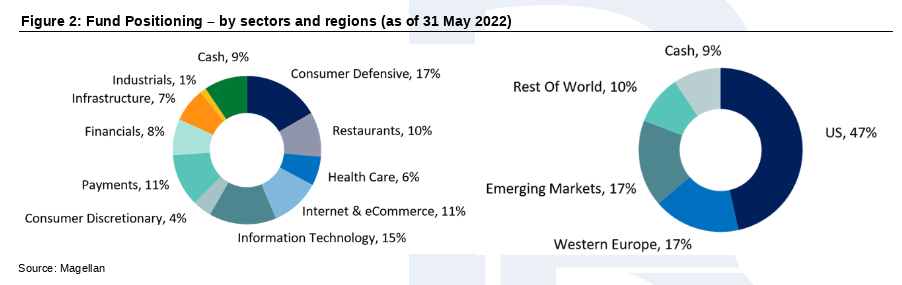
Fund Performance and Positioning 

About Fund:

The Magellan Global Fund (Unhedged) is a concentrated, currency unhedged, benchmark unaware international equities strategy that typically contains 20-40 stocks. The objectives are capital preservation and reduction of downside volatility risk, while having a minimum return objective of 9% p.a. (net of fees).

(Source: Banyantree)

DISCLAIMER for General Advice: (This document is for general advice only).

This document is provided by Laverne Securities Pty Ltd T/as Laverne Investing. Laverne Securities Pty Ltd, CAR 001269781 of Laverne Capital Pty Ltd AFSL No. 482937.

The material in this document may contain general advice or recommendations which, while believed to be accurate at the time of publication, are not appropriate for all persons or accounts. This document does not purport to contain all the information that a prospective investor may require.  The material contained in this document does not take into consideration an investor’s objectives, financial situation or needs. Before acting on the advice, investors should consider the appropriateness of the advice, having regard to the investor’s objectives, financial situation, and needs. The material contained in this document is for sales purposes. The material contained in this document is for information purposes only and is not an offer, solicitation or recommendation with respect to the subscription for, purchase or sale of securities or financial products and neither or anything in it shall form the basis of any contract or commitment. This document should not be regarded by recipients as a substitute for the exercise of their own judgment and recipients should seek independent advice.

The material in this document has been obtained from sources believed to be true but neither Laverne and Banyan Tree nor its associates make any recommendation or warranty concerning the accuracy or reliability or completeness of the information or the performance of the companies referred to in this document. Past performance is not indicative of future performance. Any opinions and or recommendations expressed in this material are subject to change without notice and, Laverne and Banyan Tree are not under any obligation to update or keep current the information contained herein. References made to third parties are based on information believed to be reliable but are not guaranteed as being accurate.

Laverne and Banyan Tree and its respective officers may have an interest in the securities or derivatives of any entities referred to in this material. Laverne and Banyan Tree do and seek to do business with companies that are the subject of its research reports. The analyst(s) hereby certify that all the views expressed in this report accurately reflect their personal views about the subject investment theme and/or company securities.

Although every attempt has been made to verify the accuracy of the information contained in the document, liability for any errors or omissions (except any statutory liability which cannot be excluded) is specifically excluded by Laverne and Banyan Tree, its associates, officers, directors, employees, and agents.  Except for any liability which cannot be excluded, Laverne and Banyan Tree, its directors, employees and agents accept no liability or responsibility for any loss or damage of any kind, direct or indirect, arising out of the use of all or any part of this material.  Recipients of this document agree in advance that Laverne and Banyan Tree are not liable to recipients in any matters whatsoever otherwise; recipients should disregard, destroy or delete this document. All information is correct at the time of publication. Laverne and Banyan Tree do not guarantee reliability and accuracy of the material contained in this document and are not liable for any unintentional errors in the document.

The securities of any company(ies) mentioned in this document may not be eligible for sale in all jurisdictions or to all categories of investors. This document is provided to the recipient only and is not to be distributed to third parties without the prior consent of Laverne and Banyan Tree.
Categories
Dividend Stocks

Mercury is Primed for Growth on Recovering Generation, Acquisitions and Development

Business Strategy & Outlook:   

Mercury is one of New Zealand’s leading producers of electricity, accounting for more than 15% of the country’s total generation. The firm enjoys a good retail presence with Mercury Energy being the largest supplier of electricity in the key Auckland region, with an estimated market share of 40%. Mercury currently operates in a favorable environment dominated by four electricity producers. Barring regulatory change, the four major players will continue to generate favorable returns on invested capital in the long run. Mercury possesses strong competitive advantages and deserves a narrow economic moat rating. Installed capacity from the firm’s hydro and geothermal generation is equivalent to about 6800 gigawatt hours, or GWh, of annual production. The firm is building its first wind farm, with full completion in late 2021 increasing average annual generation to around 7640 GWh. 

The generation business is significantly hedged by the supply of electricity to residential and industrial customers, with the added ability to alter output, should weather conditions change. For instance, when wholesale prices are low, Mercury can opt to reduce hydro output if it is more cost-effective to purchase electricity for its retail business than to produce it, though its ability to do so is limited by relatively small lake storage. The firm is affected during a dry year because of lower hydro output, which comprises about 60% of generation in normal years. Its geothermal power plants and hedging to some extent alleviate dry-year risk and provide stability to the firm’s revenue and earnings. Nationwide electricity demand has been soft because of a combination of economic weakness and more efficient energy consumption by households and businesses. Retail markets have been challenging, owing to intense competition from both incumbent gentailers and pure-play energy retailers.

Financial Strengths:  

Mercury is in sound financial health. Gearing (as measured by debt/capital) was 26% in June 2021. Net debt/EBITDA was 2.9 times in fiscal 2021, a little higher than most peers. But earnings growth and the underwritten dividend reinvestment plan should reduce net debt/EBITDA back to 2.5 times in 2023. The likely debt-funded acquisition of Trustpower’s retail division should cause credit metrics to deteriorate a little further but remain comfortable. Maintenance capital expenditure in 2022 should be about NZD 70 million. Growth capital expenditure is picking up with the commitment to build the Turitea wind farm. Other growth investments are possible. Management is committed to paying dividends based on a payout ratio of 70%-85% of free cash flow, but the potential for further special dividends has diminished because of increased growth expenditure. Should the firm have surplus free cash flows after funding growth projects, it might opt for share buybacks.

Bulls Say: 

  • Mercury is a low-cost provider of electricity attributed to its significant renewable assets.
  • The company has a strong retail electricity brand, especially in the key Auckland region.
  • A strong free cash flow is expected to support dividend growth and investment in Tilt Renewables and other growth opportunities.

Company Description: 

Mercury NZ (formerly Mighty River Power) generates more than 15% of New Zealand’s electricity and is one of the four major electricity generators and suppliers in the country. All electricity is now generated from renewable sources, which makes it one of the lowest-cost providers of electricity. The company operates nine hydro stations and five geothermal power plants, all located in the North Island. Mercury sells electricity to residential and commercial customers and has the largest share of the key Auckland market.

(Source: Morningstar)

DISCLAIMER for General Advice: (This document is for general advice only).

This document is provided by Laverne Securities Pty Ltd T/as Laverne Investing. Laverne Securities Pty Ltd, CAR 001269781 of Laverne Capital Pty Ltd AFSL No. 482937.

The material in this document may contain general advice or recommendations which, while believed to be accurate at the time of publication, are not appropriate for all persons or accounts. This document does not purport to contain all the information that a prospective investor may require.  The material contained in this document does not take into consideration an investor’s objectives, financial situation or needs. Before acting on the advice, investors should consider the appropriateness of the advice, having regard to the investor’s objectives, financial situation, and needs. The material contained in this document is for sales purposes. The material contained in this document is for information purposes only and is not an offer, solicitation or recommendation with respect to the subscription for, purchase or sale of securities or financial products and neither or anything in it shall form the basis of any contract or commitment. This document should not be regarded by recipients as a substitute for the exercise of their own judgment and recipients should seek independent advice.

The material in this document has been obtained from sources believed to be true but neither Laverne and Banyan Tree nor its associates make any recommendation or warranty concerning the accuracy or reliability or completeness of the information or the performance of the companies referred to in this document. Past performance is not indicative of future performance. Any opinions and or recommendations expressed in this material are subject to change without notice and, Laverne and Banyan Tree are not under any obligation to update or keep current the information contained herein. References made to third parties are based on information believed to be reliable but are not guaranteed as being accurate.

Laverne and Banyan Tree and its respective officers may have an interest in the securities or derivatives of any entities referred to in this material. Laverne and Banyan Tree do and seek to do business with companies that are the subject of its research reports. The analyst(s) hereby certify that all the views expressed in this report accurately reflect their personal views about the subject investment theme and/or company securities.

Although every attempt has been made to verify the accuracy of the information contained in the document, liability for any errors or omissions (except any statutory liability which cannot be excluded) is specifically excluded by Laverne and Banyan Tree, its associates, officers, directors, employees, and agents.  Except for any liability which cannot be excluded, Laverne and Banyan Tree, its directors, employees and agents accept no liability or responsibility for any loss or damage of any kind, direct or indirect, arising out of the use of all or any part of this material.  Recipients of this document agree in advance that Laverne and Banyan Tree are not liable to recipients in any matters whatsoever otherwise; recipients should disregard, destroy or delete this document. All information is correct at the time of publication. Laverne and Banyan Tree do not guarantee reliability and accuracy of the material contained in this document and are not liable for any unintentional errors in the document.

The securities of any company(ies) mentioned in this document may not be eligible for sale in all jurisdictions or to all categories of investors. This document is provided to the recipient only and is not to be distributed to third parties without the prior consent of Laverne and Banyan Tree.

Categories
Technology Stocks

SKF’s core market is treading water from a growth perspective

Business Strategy and Outlook

SKF’s core market is treading water from a growth perspective, and management’s plan for faster top-line growth to double revenue by “2030” is fairly high level in its outline and therefore difficult for investors to assess. SKF has deep engineering expertise and a leading position in ball bearings; however, growth from new market opportunities will still take time and investment. Of the high-level opportunities presented by the company, ceramic ball bearings for the electric vehicle market is one of the most promising. The market for EVs will expand over time, as the adoption is supported by regulators and consumers alike. Therefore, SKF’s ceramic bearing solution should yield positive results once EV take-up accelerates. Pricing power along with cost flexibility thanks to the adoption of robotics and other automation has enabled to SKF to weather its mostly procyclical end markets. However, the estimate is around 10% of its revenue is favoured by structural tailwinds. First, it has exposure to renewables through wind turbines and other “clean tech” end markets, which currently contribute around 9% of revenue. Second, it has an emerging connected services business, with contracts at less than 1% of revenue. However, the services offer a promising growth outlook and also welcome recurring revenue for SKF. Across capital goods companies, connected services have seen good customer take-up rates due to the productivity gains from preventative maintenance, and the same is expected for SKF’s connected services.

SKF provides its customers with measurable operational cost savings versus competitor bearings, which it can accomplish by designing its ball bearings on an application-specific basis. As one of the two largest industrial bearings suppliers, along with Schaeffler, it draws on its more than 100 years of experience in industrial application design to lower energy costs and extend the length of time between maintenance breaks. Customers are willing to pay a premium for this engineering and often sign supply contracts, as work stoppages are very costly for customers running processes for hours at a time or even on a continuous basis

Financial Strength

SKF ended the first quarter of 2022 with a moderate level of debt on its balance sheet and net debt/EBITDA of 1.2 times. This is an appropriate level for a company with mostly cyclical demand. Based on the free cash flow forecasts, if necessary, the company could pay down its gross debt balance within four years.

Bulls Say’s

SKF’s restructuring program and working-capital management program should boost medium-term cash flows and provide mid-single-digit earnings growth.

As a major supplier of ball bearings for wind turbines, the company is a beneficiary of renewables growth.

The lagging automotive division should see a marked improvement in the short term from restructuring efforts and EV growth

Company Profile

SKF’s history goes back to the first major patents in ball bearings: In 1907, SKF was the first to patent the self-aligning ball bearing, which is easily recognisable today. Along with Schaeffler, it is one of the top two global ball bearing suppliers, followed by Timken, NSK, NTN, and JTEK. Combined, these six companies supply about 60% of the world’s ball bearings. The company is based in Sweden and has a global manufacturing footprint of 108 sites and 17,000 global distributor locations. SKF operates under two segments: industrial, which has a fairly fragmented customer base, and automotive, which is the opposite, with a concentrated customer base that includes the likes of Tesla.

(Source: MorningStar)

DISCLAIMER for General Advice: (This document is for general advice only).
This document is provided by Laverne Securities Pty Ltd T/as Laverne Investing. Laverne Securities Pty Ltd, CAR 001269781 of Laverne Capital Pty Ltd AFSL No. 482937.The material in this document may contain general advice or recommendations which, while believed to be accurate at the time of publication, are not appropriate for all persons or accounts. This document does not purport to contain all the information that a prospective investor may require. The material contained in this document does not take into consideration an investor’s objectives, financial situation or needs. Before acting on the advice, investors should consider the appropriateness of the advice, having regard to the investor’s objectives, financial situation, and needs. The material contained in this document is for sales purposes. The material contained in this document is for information purposes only and is not an offer, solicitation or recommendation with respect to the subscription for, purchase or sale of securities or financial products and neither or anything in it shall form the basis of any contract or commitment. This document should not be regarded by recipients as a substitute for the exercise of their own judgment and recipients should seek independent advice. The material in this document has been obtained from sources believed to be true but neither Laverne and Banyan Tree nor its associates make any recommendation or warranty concerning the accuracy or reliability or completeness of the information or the performance of the companies referred to in this document. Past performance is not indicative of future performance. Any opinions and or recommendations expressed in this material are subject to change without notice and, Laverne and Banyan Tree are not under any obligation to update or keep current the information contained herein. References made to third parties are based on information believed to be reliable but are not guaranteed as being accurate.
Laverne and Banyan Tree and its respective officers may have an interest in the securities or derivatives of any entities referred to in this material. Laverne and Banyan Tree do and seek to do, business with companies that are the subject of its research reports. The analyst(s) hereby certify that all the views expressed in this report accurately reflect their personal views about the subject investment theme and/or company securities. Although every attempt has been made to verify the accuracy of the information contained in the document, liability for any errors or omissions (except any statutory liability which cannot be excluded) is specifically excluded by Laverne and Banyan Tree, its associates, officers, directors, employees, and agents. Except for any liability which cannot be excluded, Laverne and Banyan Tree, its directors, employees and agents accept no liability or responsibility for any loss or damage of any kind, direct or indirect, arising out of the use of all or any part of this material. Recipients of this document agree in advance that Laverne and Banyan Tree are not liable to recipients in any matters whatsoever otherwise; recipients should disregard, destroy or delete this document. All information is correct at the time of publication. Laverne and Banyan Tree do not guarantee reliability and accuracy of the material contained in this document and is not liable for any unintentional errors in the document. The securities of any company(ies) mentioned in this document may not be eligible for sale in all jurisdictions or to all categories of investors. This document is provided to the recipient only and is not to be distributed to third parties without the prior consent of Laverne and Banyan Tree.