Categories
ETFs ETFs

HACK aims to track the performance of an index that provides exposure to the leading companies in the global cybersecurity sector.

Approach

The index tracks the performance of the exchange-listed equity securities of companies across the globe that (i) engage in providing cyber defence applications or services as a vital component of its overall business or (ii) provide hardware or software for cyber defence activities as a vital component of its overall business. The fund invests at least 80% of its total assets in the component securities of the index and in ADRs and GDRs based on the component securities in the index.

Portfolio

An ETF Model Portfolio is a carefully selected portfolio of exchange traded funds (ETFs) and other exchange traded products constructed and managed by a professional investment manager.

The investment manager typically also provides regular reporting on the portfolio’s performance, along with ongoing communication on changes to the portfolios, the rationale for doing so, and broader commentary on the micro and macro environment.

BetaShares offers four series of model portfolios, each of which seeks to achieve capital growth and income streams through a careful blending of asset classes, including Australian and international equities, bonds, cash and commodities. The models are constructed using ETFs and other exchange-traded products, resulting in institutional-quality portfolios that are cost-effective, highly diversified, transparent, and simple to explain to clients.

  • Strategic asset allocation (SAA) ETF model portfolios: Built using forward-looking 10-year expected returns and risk for a diversified range of major asset classes.
  • Dynamic asset allocation (DAA) ETF model portfolios: Utilise return/risk parameters from SAA, rebalanced quarterly based upon BetaShares’ modelling of asset class misevaluations, risk objectives and economic considerations.
  • Dynamic Income model portfolios: Aim to produce total returns that are similar to the dynamic ETF models, but are weighted towards income rather than capital growth.
  • Pension Risk-Managed Model Portfolios: Uses ETPs that aim to provide enhanced income returns and/or less volatile returns through a systematic risk-management overlay.

People

dam O’Connor is a member of the BetaShares Distribution team responsible for supporting Institutional and Intermediary Broker and Adviser channels. Prior to joining BetaShares, Adam worked in stockbroking and advisory with Bell Potter Securities. Alex is responsible for leading the strategy and overall management of the business. Prior to co-founding BetaShares, Alex was closely involved in the establishment and development of several leading Australian financial services businesses including Pengana Capital and Centric Wealth. Alistair is a member of the BetaShares Distribution team, responsible for supporting Institutional and Intermediary Broker channels, as well as supporting the firm’s capital markets activities. Annabelle is a member of the BetaShares marketing team focusing on social media and content. Anthony is responsible for supporting the investment and operations functions at BetaShares. Anton is BetaShares’ internal legal adviser and is also responsible for managing the compliance function.  Ben is responsible for supporting the distribution of BetaShares funds to advisers across the Victoria and South Australia regions. Benjamin is a member of the BetaShares Distribution team, responsible for assisting with client inquiries.

Brendan is responsible for growing and servicing BetaShares Adviser business clients across Western Australia. In this role, Brendan is focused on educating advisers about the role and benefits of ETF’s and SMA’s in client portfolios and sharing updates on the expanding range of strategies available across the BetaShares product suite. Cameron’s responsibilities span supporting all distribution channels and working alongside the portfolio management team. Prior to joining BetaShares, Cameron was a portfolio manager at Macquarie Asset Management, and was responsible for the structuring and management of Macquarie’s listed and unlisted structured product offering. Cameron’s other experience includes Head of Product at Bell Potter Capital, working on JP Morgan’s Equity Derivatives desk and at Deloitte Consulting.

Performance 

The ETFMG Prime Cyber Security ETF was the first ETF to focus on the cyber security industry. It tracks an index of companies involved in hardware, software and services, classifying the underlying stocks as either infrastructure or service providers. Top holdings include Cisco Systems, Akamai and Qualys.

About Fund

FactSet ETF Analytics Scoring Methodology is one of the first wide-ranging and robust methodologies for evaluating, comparing and contrasting exchange-traded funds. The researchers and analysts at FactSet developed the system. The result of thousands of hours of research, debate and testing, FactSet ETF Analytics Scoring Methodology provides a comprehensive structure for investors to analyze ETFs. FactSet’s quantitative system allows an investor to evaluate a fund at a glance, aggregating a sweeping range of detailed, often-difficult-to-obtain data points. FactSet’s Letter Grade combines the Efficiency and Tradability score evaluating costs to the investor. The combined score is assigned a letter grade (A-F) providing an institutional-caliber view on how well run and how liquid the ETF is. Efficiency includes risks, which are potential costs. Funds that minimize these risks can be more efficient.

(Source: Betashare)

DISCLAIMER for General Advice: (This document is for general advice only).

This document is provided by Laverne Securities Pty Ltd T/as Laverne Investing. Laverne Securities Pty Ltd, CAR 001269781 of Laverne Capital Pty Ltd AFSL No. 482937.

The material in this document may contain general advice or recommendations which, while believed to be accurate at the time of publication, are not appropriate for all persons or accounts. This document does not purport to contain all the information that a prospective investor may require.  The material contained in this document does not take into consideration an investor’s objectives, financial situation or needs. Before acting on the advice, investors should consider the appropriateness of the advice, having regard to the investor’s objectives, financial situation, and needs. The material contained in this document is for sales purposes. The material contained in this document is for information purposes only and is not an offer, solicitation or recommendation with respect to the subscription for, purchase or sale of securities or financial products and neither or anything in it shall form the basis of any contract or commitment. This document should not be regarded by recipients as a substitute for the exercise of their own judgment and recipients should seek independent advice.

The material in this document has been obtained from sources believed to be true but neither Laverne and Banyan Tree nor its associates make any recommendation or warranty concerning the accuracy or reliability or completeness of the information or the performance of the companies referred to in this document. Past performance is not indicative of future performance. Any opinions and or recommendations expressed in this material are subject to change without notice and, Laverne and Banyan Tree are not under any obligation to update or keep current the information contained herein. References made to third parties are based on information believed to be reliable but are not guaranteed as being accurate.

Laverne and Banyan Tree and its respective officers may have an interest in the securities or derivatives of any entities referred to in this material. Laverne and Banyan Tree do and seek to do business with companies that are the subject of its research reports. The analyst(s) hereby certify that all the views expressed in this report accurately reflect their personal views about the subject investment theme and/or company securities.

Although every attempt has been made to verify the accuracy of the information contained in the document, liability for any errors or omissions (except any statutory liability which cannot be excluded) is specifically excluded by Laverne and Banyan Tree, its associates, officers, directors, employees, and agents.  Except for any liability which cannot be excluded, Laverne and Banyan Tree, its directors, employees and agents accept no liability or responsibility for any loss or damage of any kind, direct or indirect, arising out of the use of all or any part of this material.  Recipients of this document agree in advance that Laverne and Banyan Tree are not liable to recipients in any matters whatsoever otherwise; recipients should disregard, destroy or delete this document. All information is correct at the time of publication. Laverne and Banyan Tree do not guarantee reliability and accuracy of the material contained in this document and are not liable for any unintentional errors in the document.

The securities of any company(ies) mentioned in this document may not be eligible for sale in all jurisdictions or to all categories of investors. This document is provided to the recipient only and is not to be distributed to third parties without the prior consent of Laverne and Banyan Tree.

Categories
Funds Funds

Realindex Australian Share-Class A: A well versed, Economical Option with Good Background

Approach
Realindex uses a systematic index method employing four equally weighted measures of a company’s economic size to rank and weight stocks in the portfolio. These criteria are adjusted sales, cash flow, and dividends and latest available adjusted book value. Additional earnings quality, near-term value, and debtcoverage filters act to reduce exposure to stocks with greater uncertainty. A signal was also introduced in November 2015 that downweights stocks with negative momentum and overweights stocks with positive momentum. As a part of its endeavor to improve current metrics, Realindex has more recently refined the book value metric to factor in intangibles as well by adjusting it with capitalize R&D and marketing expenses. The filters have contributed to a value bias and tilt to established companies that typically trade at a discount. This alternative approach to traditional index investing aims to eliminate the relationship between portfolio weighting and over/undervaluation associated with weighting a portfolio by market cap. The portfolio is rebalanced quarterly, resulting in average annual turnover of about 15%. The team handles all aspects of research, portfolio management, implementation, and execution with a focus on minimizing trading costs and market impact.


Portfolio
Realindex constructs a diversified, value-leaning portfolio. The strategy’s factors and price filters can lead to some differences relative to the more commonly used S&P/ASX 200 Accumulation Index. For example, the portfolio typically has lower price/book ratios and higher dividend yields. Realindex’s absolute weighting to most sectors remains relatively stable because the fundamental size characteristics tend not to fluctuate wildly unlike the sector weights fluctuation in market-cap benchmarks. Other deviations have been a historic tilt away from healthcare and real estate. Relative to the category index, S&P/ASX 200 Index, the strategy is value-focused and yield-oriented. Large-cap bias is apparent in the portfolio, but it is relative to the category average. As of November 2021, the portfolio was overweight in financial services and underweight in resources and healthcare. Realindex’s portfolio, traditionally, has remained quite similar to market-cap benchmarks overall. Historically, active share has hovered around 20%.

People
Realindex has been through a significant phase of transition in the past couple of years bought about by the end of the partnership with RAFI and the exit of a few senior portfolio managers. This has provided an opportunity for Realindex to revamp its overall team structure and bring on experienced investment professionals. The experienced David Walsh has joined as the head of investment, leading portfolio management and research, which Scott Hamilton leads. With the hires of Joana Nash and Ron Guido as experienced senior quant portfolio managers, Realindex has also beefed up its quant research capabilities.
The team is nimbler now for prioritization and effective collaboration on research initiatives and efficient implementation of the research outcomes, although it is preferred to have clearer lines between the research and portfolio management teams. The visible progress made in the trailing 18 months in research projects (for example, ESG factor impact on price and incorporating intangibles into the book value) augmenting the investment process through the implementation of novel signals is testimony of the team’s collective ability. The recent departure of experienced senior portfolio manager Raelene De Souza is unfortunate. Historically, Realindex has been successful in attracting top investment talent. But the length of their association with the firm has been shorter than it is prefered.


Performance
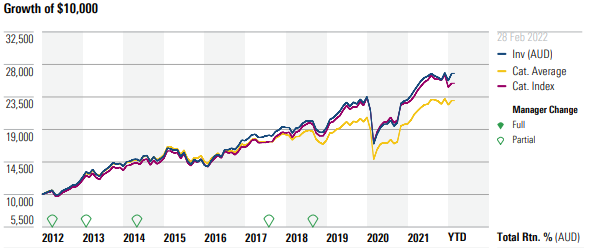
Realindex Australian Shares has delivered impressive peer-relative performance from inception through February 2022. Its five-year return of 8.5% per year as of February 2022 has easily outpaced the category average but only matched the broader market’s index return, indicating the tough environment it has been for value managers. This performance is principally attributed to the overweighting in materials, underweighting in healthcare, and energy. Better stock inclusion from the resources and consumer cyclical sectors has been additive too. Specifically, overweightings in BHP Group and Wesfarmers has added to performance and offset marginally by the overweighting in Westpac Banking. Amid the pandemic-induced uncertainties across the market, the strategy was admirably more resilient than the average category manager. The impressive outperformance was largely fueled by the strategy’s overweighting in materials, consumer cyclical, and consumer staples (a recurring theme across short- and long-term performance), although slightly offset by its overweighting in financial services. Over the trailing year through February 2022, the strategy has outperformed the S&P/ASX 200 Index but marginally stayed below the category average as value stocks have staged a reversal.

About Fund:
Realindex forms a universe of Australian companies based on accounting measures.Factors such as quality, near – term value and momentum are applied to form a final portfolio of companies. The resulting portfolio has a value tilt relative to the benchmark and provides the benefits of being lower in cost, lower turnover and highly diversified compared to traditional active investment strategies. Realindex overhauled its investment team with an aim to create a nimbler team structure and has hired investment professionals with a high skillset and experience level. The new team has made real progress in the trailing 18 months defining the research agenda and prioritizing projects in terms of their potential to value add. These developments paint a positive picture for the strategy; however, investors should note that the team’s tenure is short and Realindex’s track record in team turnover has not been impressive. As such, it is alleged for the investment team to exhibit longevity before experts’ conviction level is strengthened.

(Source: Morningstar)
General Advice Warning
Any advice/ information provided is general in nature only and does not take into account the personal financial situation, objectives or needs of any particular person.

Categories
Fixed Income Fixed Income

Cheap passive exposure to Australian fixed income

Approach

This strategy aims to track the Bloomberg Ausbond Composite 0+ Index with a tracking error of 0.05% per year or less (before fees). IShares is typically able to achieve full replication of the government-bond component in the portfolio because of ample liquidity and breadth. To alleviate liquidity challenges, the firm uses stratified sampling to acquire corporate and supranational exposures–an industry-standard approach, but one in which iShares excels thanks to its sophisticated global trading systems and experienced team. When the team can’t buy all the bonds in the index at a reasonable price, it will instead buy a basket of bonds that has similar credit and duration risks within allowable tolerance ranges. The team also employs strategies like securities lending to generate additional returns, helping to offset the performance drag from factors like fees and trading costs. IShares’ scale further minimises trading costs; a large active book and the firm’s ETF business allow for cross-trades and wide broker access. IShares thus executes trades cheaply, which is crucial in index fund management. It’s worth noting that Bloomberg’s index assumes distributions earn no interest, whereas iShares may accrue interest on its distribution cash balances. This may cause some tracking error, but ultimately it is a positive tailwind.

Portfolio

This strategy aims to fully replicate the Bloomberg AusBond Composite 0+ Index. Factoring cost, liquidity, and existing diversification if it doesn’t make sense to own all the bonds on issue, it will use stratified sampling to buy a basket of bonds with similar credit and duration risks. As of 28 Feb 2022, the index was composed of government and semigovernment bonds (85%), supranationals (5%), and corporate bonds (9%). The fund invests in high-quality bonds, with AAA rated debt constituting 71% of the benchmark’s quality exposure. Banks and other financials issue most of the credit in the index. The fund’s duration continues to increase with the benchmark as yields mostly hovered around historic lows barring the recent spike, up from 4.95 years at October 2016 to 5.8 years at 28 Feb 2022. The lengthening duration is a result of Commonwealth Government Bonds being issued at longer tenures, such as 30 years. But it means the fund faces the risk of rising yields globally, when we would expect active managers in this space to outperform their long-duration passive peers. Overall credit quality and appropriate diversification make this strategy an appropriate core exposure.

Performance: In terms of Annualised and Cumulative basis

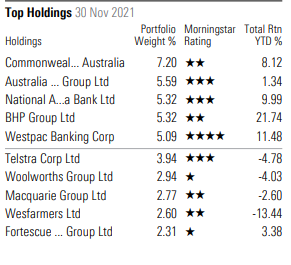
Top 10 Holdings of the fund

About the fund

The fund aims to provide investors with the performance of the Bloomberg Aus Bond Composite 0+ Yr Index SM, before fees and expenses. The index is designed to measure the performance of the Australian bond market and includes investment grade fixed income securities issued by the Australian Treasury, Australian semi-government entities, supranational and sovereign entities and corporate entities.

(Source: Morningstar)

General Advice Warning

Any advice/ information provided is general in nature only and does not take into account the personal financial situation, objectives or needs of any particular person.

Categories
Commodities Trading Ideas & Charts

Pioneer Has No Plans to Deviate Away From Winning Variable Dividend Strategy

Business Strategy and Outlook

Pioneer Natural Resources is one of the largest Permian Basin oil and gas producers overall, and is the largest pure play. It has about 800,000 net acres in the play, all of which is located on the Midland Basin side where it believes it can get the best returns.That gives Pioneer an extensive runway of low-cost drilling opportunities primarily targeting the Wolfcamp A, Wolfcamp B, and Spraberry reservoirs. Like other Permian operators, Pioneer’s production is weighted toward liquids—over 80% of its output is crude oil and natural gas liquids, boosting unit revenue. By focusing on the most productive parts of the Permian, it is able to keep its unit costs well below the peer average. Getting into the basin early also means the firm also enjoys relatively low royalty rates, giving it a further advantage over many of its competitors. Pioneer has expanded fairly rapidly, with annual production growth averaging 10%-15% over the last decade or so. But the company is now prioritizing generous shareholder distributions ahead of further volume expansion. The current plan calls for no more than 5% annual growth while reinvesting much less than 100% of operating cash flows. The remaining surplus will be used to preserve Pioneer’s very impressive balance sheet, and to return cash to shareholders via a part-variable dividend.

Financial Strength

Pioneer’s leverage ratios were uncharacteristically high for much of 2021, owing to two substantial acquisitions (Parsley and DoublePoint). But the firm has been generating substantial free cash since then, and the subsequent divestiture of the Delaware Basin assets that were bundled with these acquisitions improved the firm’s balance sheet even further (with proceeds exceeding $3 billion). As a result, the firm now has one of the strongest balance sheets in the segment, with very low leverage ratios and at strip prices, the firm will reach zero net debt by the end of 2022.After the last reporting period, net debt/EBITDA was around 0.4 times and debt/capital is 23%. Management has mentioned a leverage ratio cap of 0.75 times, but really wants absolute debt to be as low as possible, or zero, so it can capitalize in cyclical downturns by aggressively buying back stock without worrying about the impact on the balance sheet.The firm has around $3 billion in maturities due between now and 2025, all of which can be comfortably funded from cash on hand or from operating cash flows (without compromising the firm’s ability to pay the fixed and variable components of its dividend). It has ample liquidity in reserve, too, with another $1.5 billion available on its undrawn credit facility.

Bulls Say  

  • Pioneer’s low-cost Permian Basin activities are likely to generate substantial free cash flows in the years to come, assuming mid cycle prices ($55/bbl for WTI). 
  • The firm intends to target a 10% total return for shareholders via its base dividend, a variable dividend with a payout of up to 75% of free cash flows, and 5% annual production growth. 
  • Pioneer has a rock-solid balance sheet and is able to generate free cash flows even during periods of very weak commodity prices.

Company Profile

Headquartered in Irving, Texas, Pioneer Natural Resources is an independent oil and gas exploration and production company focusing on the Permian Basin in Texas. At year-end 2021, Pioneer’s proven reserves were 2.2 billion barrels of oil equivalent with net production for the year of 612 mboe per day. Oil and natural gas liquids represented 68% of production

(Source: Morningstar)

  • Relative to the pcp: (1) 

General Advice Warning

Any advice/ information provided is general in nature only and does not take into account the personal financial situation, objectives or needs of any particular person.

Categories
Dividend Stocks

Inghams Group – The Board declared a fully franked Dividend of 6.5 cps, in line with the pcp, and Equates to Payout Ratio of 60.9%

Investment Thesis:

  • Trading on undemanding multiples and below our valuation. 
  • Potential for an improvement in the pricing environment. 
  • Quality management team who has managed disruptions for the Covid-19 pandemic well. 
  • Quality assets and operates as Australia and New Zealand’s largest integrated poultry producer.
  • Project Accelerate has proven successful in driving automation and labour productivity, which supports earnings uplift despite decrease in revenue.  
  • Procurement initiatives implemented with benefits in line with expectation.
  • Investing to increase capacity and capability across the business in Australia and New Zealand plants.
  • Capital management initiatives are possible with a strong balance sheet.

Key Risks:

  • Re-negotiation of key contracts with large customers on unfavourable terms. 
  • Increase in feed and electricity costs, which may be pushed to customers through market price increases, reducing competitiveness. 
  • No news on the appointment of a new CEO creates uncertainty. 
  • Customer concentration risk in QSR (Quick Service Restaurants) and Supermarkets. 
  • Susceptible to exotic disease breakouts, impacting ING’s ability to supply poultry products. 
  • Significant reduction in volume and quality from parent stock supplier.
  • Material interruptions to ING’s complex and interlinked supply chain.

Key Highlights:

  • Group core poultry sales volumes grew +5.6%, driven by strong volume growth of +6.5% in Australia.
  • Statutory EBITDA of $220.4m, and Underlying EBITDA of $222.4m, was up +2.2% and +1.7%, respectively.
  • Statutory NPAT of $38.4m, up +8.8% and Underlying NPAT of $39.7m, up +5.9%
  • Cash flow from operations of $186.6m, was up +4.7%. Cash conversion ratio of 83.5% reflects seasonal working capital cycle and in-line with the pcp.
  • ING retained a solid balance sheet with net debt of $264.6m and leverage of 1.3x, a significant reduction from 1.7x in the pcp.
  • Total capital expenditure of $24.0m was lower than the pcp, reflecting completion of hatchery projects, ongoing project disruptions caused by Covid-19 lockdowns and delays in equipment being shipped.
  • The Board declared a fully franked dividend of 6.5 cps, in line with the pcp, and equates to payout ratio of 60.9% of Underlying NPAT post AASB 16 adjustments, which is at the lower end of ING’s 60 – 80% target range.
  • In Australia segment, Core poultry volumes grew +6.5% to 203.4kt, despite Covid-19 lockdowns and challenging market conditions. Revenue grew +1.9% driven by core poultry revenue growth of +2.2%, which grew despite weak pricing across the Wholesale channel due to excess supply, partially offset by feed revenue, declining -2.0% as customers transition supply away in preparation for closure of the ING’s WA Feedmill. Underlying EBITDA declined -0.3% to $185.1m, reflecting a lower Intercompany royalty charge, reduced by $3.2m.
  • In New Zealand segment, Core poultry volumes were flat at 33.7kt, as Covid-19 lockdowns were reintroduced. Core poultry revenue increased +3.6%, due to price increases applied across all channels to help offset higher feed costs and inflationary pressures related to supply chain disruption. Underlying EBITDA of $19.1m increased $3.3m versus the pcp, with the change to intercompany royalty charge accounting for $3.2m.

Company Description:

Inghams Group Ltd (ING) is Australia and New Zealand’s largest integrated poultry producer. The Company produces and sells chicken, turkey and stock feed that is used by the poultry, pig, dairy and equine industries. 

(Source: Banyantree)

General Advice Warning

Any advice/ information provided is general in nature only and does not take into account the personal financial situation, objectives or needs of any particular person.

Categories
Daily Report Financial Markets

Japan Market Outlook – 25 March 2022

Categories
Daily Report

Morning Report Global Markets Update – 25 March 2022

Categories
Daily Report Financial Markets

European Market Outlook – 24 March 2022

Categories
Analyst videos Brokers call Brokers Call Expert Insights Fund Manager Interviews Philosophy Stock Talks Technical Picks VidCons Videos

Brokers Call – 24 March 2022

Categories
Daily Report Financial Markets

Indian Market Outlook – 24 March 2022